Forklift Battery Certification Standards: What Matters Most for Safety?
Key Highlights
- Forklift batteries are involved in numerous serious injuries and fatalities annually, underscoring the need for rigorous safety standards.
- Certification from UL, SGS, and TÜV involves standardized tests like thermal abuse, impact, and electrical safeguards to ensure battery safety under extreme conditions.
- Regional market preferences influence certification requirements, with UL dominating North America and SGS/TÜV being more prominent in Europe and Asia.
- Ongoing compliance, including factory audits and change management, is essential to maintain certification and safety standards over time.
- Third-party certification is a critical indicator of a battery’s safety performance, helping manufacturers and users mitigate risks associated with lithium-ion technology.
Every June, National Forklift Safety Day serves as a reminder that material handling equipment is simultaneously one of the most productive and most hazardous categories of industrial machinery. Forklifts are involved in roughly 85 fatal accidents and nearly 35,000 serious injuries in the United States every year (even though batteries are very rarely the cause). As the industry accelerates its transition to electric from propane and diesel-powered machines (often bypassing lead-acid batteries) to lithium-ion power, battery certification safety standards are becoming increasingly important.
The question facing fleet managers, procurement officers and operations directors is not simply “Is my battery safe?” but “How do I know it is safe, and who validated that claim?”
The answer sits at the intersection of three globally recognized testing and certification bodies: UL (Underwriters Laboratories), SGS (Société Générale de Surveillance) and TÜV (Technischer Überwachungsverein). Each carries genuine technical authority. Each tests to rigorous standards. And each carries a different weight depending on where in the world you are doing business.
Why Certification Matters More Than Ever
Lithium-ion batteries for industrial forklifts represent a significant departure from the lead-acid chemistry that powered material handling for over a century. The energy density is higher, the charge cycles are longer, and the performance is superior. So is the potential risk if a battery is not engineered and validated correctly.
Thermal runaway—the chain reaction that can cause a lithium cell to overheat, vent and in worst cases, ignite—is the safety scenario that keeps engineers and risk managers awake. No certification eliminates that risk entirely. But rigorous third-party testing to recognized standards is how the industry separates batteries that have been proven safe under controlled abuse conditions from those that have not.
For industrial applications, the applicable UL standards are specific. Forklift lithium batteries must be tested against UL 2580, the standard for battery systems used in electric vehicles, which subjects packs to high-intensity abuse conditions, including short circuit, elevated temperature, mechanical impact and vibration. Aerial work platform batteries may reference UL 2580 or UL 2271, depending on energy levels. Energy storage system batteries fall under UL 1973, with full system certification under UL 9540. These are not interchangeable; the standard that applies to your product depends on the application, the voltage and the energy class.
The testing process itself, whichever body conducts it, also requires an ongoing relationship: factory audits, annual reviews, and change management protocols whenever cells, BMS components, or structural elements are modified. Certification is not a one-time stamp. It is a living compliance relationship.
UL, SGS, and TÜV: Side by Side
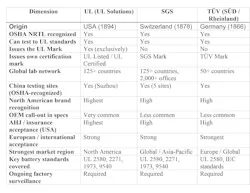
All three bodies are recognized as Nationally Recognized Testing Laboratories (NRTLs) by OSHA, the U.S. agency with authority over workplace safety. That is the baseline regulatory requirement for electrical products used in American workplaces. From that shared foundation, the three diverge in ways that matter commercially. The table below captures the key dimensions.
What’s Under the Hood? (The Core Tests)
Whether you choose UL, TÜV, or SGS, the battery must survive a “torture test” to ensure it won’t become a liability in your warehouse. These tests are standardized across all labs:
Thermal Abuse. The battery is subjected to extreme temperature swings (e.g., -20°C to 70°C) to ensure it remains stable.
Mechanical Torture. This includes crush tests (applying tons of pressure), impact tests (dropping weights), and a roll-over test to simulate a forklift collision.
Electrical Safeguards. Testing the battery management system (BMS) to ensure it shuts down safely during overcharging or a short circuit.
Fire Propagation. Ensuring that if one cell fails, the entire battery pack doesn’t turn into an uncontainable thermal runaway event.
The takeaway is straightforward: When it comes to technical rigor and the test items themselves, there is no essential difference between the three. What changes is the mark on the certificate, and the commercial weight that mark carries in a given market.
The Geography of Trust
Here is the practical reality: These are all legitimate, globally respected certification bodies. The testing they perform to UL standards is functionally equivalent. The difference is not safety; it is a commercial signal.
North America’s testing, inspection and certification (TIC) market is projected to grow from $239 billion in 2025 to nearly $283 billion by 2030, driven in part by the electrification of industrial vehicles and tighter regulatory enforcement. Within that growth, one of the clearest regional dynamics is the divergence between U.S. market expectations and the rest of the world.
In North America, and particularly in the U.S. industrial battery space, UL certification increasingly functions as the default market expectation. OEM qualification processes, insurance assessors like FM Global, and local fire marshals with AHJ authority all tend to orient toward UL. An absence of the UL mark does not automatically close a door, but it adds friction: more explanation is required, more flexibility needed from the buyer.
Outside North America, the picture shifts. SGS and TÜV carry equivalent or superior commercial weight in European, Asian and emerging market contexts. For a manufacturer supplying customers across multiple continents, a single-body strategy (e.g., pursuing only UL) may leave significant gaps in international market access.
Safety Starts with the Standard
The spirit of National Forklift Safety Day is not paperwork compliance. It is the genuine protection of the people who operate, maintain and work around powered industrial equipment every day. (Full disclosure – the author of this article works for ENEROC USA; all ENEROC batteries are SGS-certified, and some models have double SGS/UL certifications.)
Certification from UL, SGS, or TÜV is not a guarantee against every possible failure. It is evidence that an independent, technically qualified body subjected a battery to rigorous, standardized abuse testing, and that the battery performed within safe parameters. It is the manufacturer’s commitment, validated externally, that the product has been built and tested to protect the people who rely on it.
UL remains the gold standard for North American market access and commercial credibility. SGS offers a proven, globally scalable NRTL pathway with strong international acceptance. TÜV brings European engineering rigor and broad recognition across international markets. None of these is the wrong answer. The wrong answer is a battery with no credible third-party certification at all.
Safety starts with the standard. Make sure yours is built on one.
About the Author
 Maxim Khabur
Maxim Khabur
marketing director
Maxim Khabur is director of marketing with ENEROC USA, a provider of industrial lithium batteries. He previously led marketing at Bluwater and OneCharge, and was elected chairman of the Advanced Energy Council, representing a group of member companies of MHI.