Supply Chain Scenarios to Consider Due to War in Iran

The supply chain complications companies are currently facing are beyond what many have experienced before. "The conflict is not creating a single disruption," said David Fairnie, Principal Supply Chain Security Consultant at BSI Consulting, "It’s created multiple interacting shocks across logistics, energy markets, and geopolitical risk perception. Companies are therefore not managing a traditional supply chain interruption. They are operating in an environment where transport routes, commodity prices, insurance markets, and geopolitical risk are all shifting at once. This combination makes recovery slower and less predictable, even if the immediate conflict resolves in the next few weeks."
To help companies better understand the situation, he offers this analysis.
Shipping routes
This is already forcing shipping companies to rethink global routing patterns. Red Sea under threat and the Strait of Hormuz compromised, the two primary maritime corridors linking Asia and Europe are also now under pressure. Due to this, many vessels have been forced to reroute around the Cape of Good Hope, which adds significant transit time and critical fuel costs.
Let’s say the conflict ends quickly; that still means recovery is going to be uneven. Vessel repositioning, port congestion, and delayed cargo flows would take weeks or months to fully normalize. The consequence is a period of structural inefficiency in global shipping capacity, meaning cargo transit times remain longer and freight costs remain elevated (even after the immediate crisis subsides).
Insurance Premiums are often overlooked
One thing that often gets overlooked in these situations is the role of insurance markets. When security risks increase, in places like the Gulf, insurers raise war-risk premiums for vessels entering those waters. Those premiums spike very quickly when tensions escalate, and don’t drop right away, even if conditions improve. Insurers typically want to see sustained stability before reducing rates again. In practical terms, we’re looking at a timeline where war-risk premiums stay elevated for several months.
Over the first three to six months, they gradually come down as shipping routes stabilize, and then over roughly six to twelve months, they might move back toward pre-crisis levels if the region remains calm. In the meantime, those insurance costs get passed straight through to freight rates.
Iranian Cyber Attacks
Iran has developed a cyber apparatus they’ve historically used as an asymmetric tool when tensions escalate. If this conflict stretches out, we can expect to see an uptick in cyber activity. What this tends to look like is attacks against logistics companies, energy infrastructure, or financial institutions (systems that keep logistics and infrastructure running, coordinate global supply chains). When those systems start experiencing disruptions while already under pressure, the impact can compound quickly.
Long-term conflict: Financial Markets
If this turns into a prolonged situation, financial markets are going to start repricing risk pretty quickly. The Strait of Hormuz carries roughly 20% of global oil supply, with sustained instability, energy markets stay volatile, and that feeds directly into inflation expectations. Typically, what we see here is capital moving toward safer assets while sectors exposed to global trade/manufacturing start feeling pressure. Shipping costs rise, insurance premiums stay elevated, and companies begin flagging higher input costs and longer delivery times. When those conditions persist for several months, financial markets start factoring in slower global growth due to supply chains simply are more expensive and less predictable to operate.
Food Supply Chains
Food supply chains get hit from both sides in this scenario. Fertilizer disruptions can reduce crop yields for months down the road, especially during the spring planting season. On the other hand, higher energy prices immediately increase the cost of processing, storing, and transporting food. It’s imperative to understand that food production is extremely energy-intensive. We’re talking about milling, refrigeration, packaging, and trucking. Every step uses fuel or electricity. When oil and natural gas prices rise, those operating costs move higher almost immediately.
What you end up with is a two-stage effect. First, energy price spikes mean food processors and distributors see their costs rise. Then later, if fertilizer shortages reduce harvest sizes, the supply of agricultural commodities tightens. Put those together, and it’s a straight road to how food inflation could pick up across multiple regions.
Industry Supply Chains
Semiconductors – Taiwan
One of the more interesting second-order effects if this crisis is prolonged, doesn’t necessarily deal with the Middle East’s actions itself, but the US. If we become heavily engaged in a military conflict in the region, global markets shift focus to strategic bandwidth and geopolitical risk elsewhere. The region that is immediately brought into the conversation is Taiwan.
Taiwan sits at the center of the global semiconductor supply chain and produces most of the world’s most advanced chips. Without an actual escalation in the Taiwan Strait, the perception of geopolitical risk around Taiwan rises, and companies that depend on semiconductor supply (automakers to electronics manufacturers) start taking contingency planning much more seriously, and look to diversifying suppliers, building larger inventories, or shifting production strategies because the potential disruption here would be so significant.
Pharmaceuticals
The pharmaceutical sector has an interesting vulnerability here, as so much of the world’s generic drug manufacturing sits in India. India produces a huge share of global generic medicines and active pharmaceutical ingredients. Those production facilities are very sensitive to energy prices and logistics costs.
Oil prices spiking means cargo routes get disrupted at the same time, so you’re essentially hitting pharmaceutical supply chains from two directions. Manufacturing becomes more expensive due to energy costs, and shipping those products becomes more complicated because air freight capacity tightens and rates go up.
For most drugs, we wouldn’t see immediate shortages, but we could start seeing delays or tighter inventories in markets that depend heavily on Indian exports. At that point, pharmaceutical companies shift into inventory management mode; they’re trying to keep supply steady while the logistics environment stabilizes.
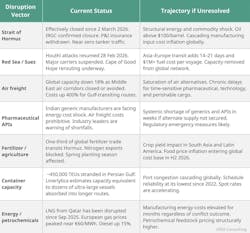
BSI also released a survey, What the Middle East Conflict Means for Supply Chains: Two Roads from Here
The following is an excerpt of these two scenarios.
Scenario A-- Swift end: Conflict concludes within three weeks
Hostilities cease. The Strait of Hormuz reopens. Your focus shifts from crisis management to structured recovery - but the window to act is narrow, and the mistakes at this stage are costly.
In this scenario, political and military pressures, domestic opposition to the campaign, international mediation, and shifts within Iran’s leadership structure that create an opportunity for a transitional negotiating position, or simply the logic of exhaustion, produce a ceasefire within three weeks. The Strait of Hormuz begins to reopen to commercial traffic. Insurance markets, cautiously, begin reinstating P&I cover. Carriers start repositioning vessels.
This sounds like good news. It is, but it’s not the end of your problem. It’s the beginning of a different and more complex one.
Why recovery is harder than it looks: The assumption that a ceasefire produces a rapid return to normal is one of the most dangerous cognitive traps in supply chain crisis management. It conflates the cessation of the immediate cause with the resolution of its consequences, and those two things operate on completely different timescales.
Vessels rerouted around Africa do not teleport back: They complete their current voyages, some adding three to four weeks to transit times, before returning to normal routing. The capacity squeeze is self-perpetuating even after the trigger is removed.
Port congestion that has been building for two weeks does not clear in two weeks: It clears over months, as the backlog of delayed vessels works through constrained port infrastructure. Rotterdam, Felixstowe, Hamburg, and Singapore have all managed versions of this before. It’s slow and expensive.
Insurance reinstatement is cautious and tiered: War-risk premiums do not return to pre-crisis levels immediately. The actuarial calculation responds to evidence of sustained stability, not a ceasefire announcement. Expect elevated premiums for three to six months minimum.
Energy prices do not decompress instantly: The market has priced in sustained risk. The unwinding of that position takes time, especially if there is any ambiguity about the durability of the ceasefire or the stability of the post-conflict Iranian political situation.
Supplier relationships and inventory positions that were damaged during the crisis do not self-repair: Every supplier that was unable to deliver, every customer that was told lead times had extended, and every contract where force majeure was invoked is a relationship that now requires active repair work.
The recovery trap
The greatest risk in Scenario A is that organizations exhale at the news of a ceasefire and stand down their crisis management structures before the recovery is actually complete. The Supply Chain Crisis Committee should remain in session, at reduced frequency but with full mandate - until supply chain performance metrics have returned to pre-crisis baselines across all key indicators. That is the exit criterion. Not the ceasefire announcement.
What you should be doing under Scenario A
Maintain the crisis governance structure through the recovery phase
Stand your Supply Chain Crisis Committee down in stages, not all at once. Move from daily sessions to every-other-day, then weekly, then monthly - each transition triggered by a defined recovery milestone, not by elapsed time or a ceasefire announcement. Recovery governance requires accountability just as crisis management does.
Conduct a rapid recovery sequencing exercise within 48 hours of ceasefire
Map your critical supply chains against their recovery dependency. Which routes reopen first? Which suppliers can ship immediately? Which inventory gaps are most urgent? Build a recovery priority list and assign accountable owners to each recovery action. This is your recovery management plan - it does not write itself.
Manage the transition from emergency to normal procurement deliberately
The emergency sourcing decisions made under crisis conditions - non-approved suppliers, premium logistics costs, buffer stock purchases at spot rates - need a formal exit. Audit every emergency procurement decision, assess which represents a genuine improvement on precrisis arrangements, and transition those you want to retain into standard commercial frameworks. Close those you do not, in a controlled manner that does not leave operational gaps.
Repair supplier and customer relationships - proactively and with evidence
Every supplier that struggled to deliver, and every customer that was impacted by your supply constraints, is making a judgment about your organization right now based on how you behaved during the crisis and how you are behaving in recovery. Proactive communication, honest acknowledgement of the impact, and a clear forward commitment will preserve more relationships than silence. Reactive responses to complaints will not.
Commission a formal post-crisis structural review - while it still matters
Within 30 days of recovery reaching baseline, commission a formal after-action review of the crisis and recovery. Scope it to include: the supply chain vulnerabilities the crisis exposed; the governance, risk management, and operational gaps that were discovered; the decisions that worked and the ones that did not; and the structural changes required to reduce vulnerability to the next event. Present the findings to the board with a costed improvement programme. The window in which the board will fund this work is short - it closes as operational memory fades.
Recalibrate your risk register and scenario library against what actually happened
Your risk register contained an entry for Middle East geopolitical risk. How well did it describe what actually happened? How accurate were the impact estimates? How adequate were the pre-crisis mitigations? The answers to these questions are the most valuable risk intelligence update your organization will receive this year. Use them.
Scenario B-- Prolonged spread: Conflict extends and widens
Hostilities continue beyond three weeks. The conflict draws in proxy networks, spreads to new geographies, and produces a sustained, multi-vector disruption to global supply chains that extends well beyond the Middle East.
In this scenario, a combination of sustained regional tension involving Iran, increased activity by affiliated groups in neighboring countries, limited early progress in US- and Israel‑aligned diplomatic efforts, and broader instability across the Middle East contributes to a conflict that extends beyond three weeks.
The consequences for global supply chains are not simply “more of the same”. They are qualitatively different. What begins as a Middle Eastern logistics and energy disruption evolves into a structural, multi-geography shock that challenges supply chain architectures across every sector and every region simultaneously.
Senior supply chain leaders need to understand the geographic and sectoral contagion pathways through which a prolonged conflict in the Middle East translates into supply chain damage in regions and sectors that appear, on the surface, to be remote from the conflict.
The critical insight for Scenario B In a prolonged conflict, the Middle East is not where your supply chain problem is; it’s where your supply chain problem started. By week four or five of sustained hostilities, the material operational challenge for most senior supply chain executives will be managing cascading disruptions in South Asia, East Asia, Europe, and their own domestic markets. The map of disruption expands. The number of simultaneous decisions required multiplies. The governance, risk management, and operational structures designed for a single-vector crisis are insufficient for what Scenario B demands.
Your thinking priorities under Scenario B
Shift mental model: You are no longer in incident management; you are in protracted crisis leadership.
The single most important cognitive shift required of senior supply chain leaders in Scenario B is this: the mental model of incident management - in which there is a defined beginning, a defined response, and a defined recovery - is no longer the right frame. You are in protracted crisis leadership. The rules are different.
In incident management, the question is: how do we get back to normal? In protracted crisis leadership, the question is: what is the new operating baseline we need to build, and how do we build it - while continuing to manage ongoing disruption at the same time?
This shift has profound implications. It means that your crisis governance structure is not temporary; it’s a parallel management capability that will need to operate indefinitely alongside normal business operations. It means that your people will experience crisis fatigue, and you need to design against that. It means that your financial reserves allocated to crisis response will be drawn down over months, not weeks.
And it means that the strategic decisions you make now - on sourcing, routing, supplier relationships, and inventory - are not emergency measures. They are the foundations of a new supply chain architecture.
Think in waves, not snapshots
Scenario B unfolds in waves of disruption, not as a single static event. Each week that the conflict continues produces new escalation events, new proxy activations, new market repricing, and new geographic spread. Your thinking needs to be wave-based: what is the current wave, what is the next probable wave, and what do I need to do now to be positioned for the wave after that?
This requires genuine scenario planning capacity, not the annual tabletop exercise variety, but a live, continuously updated assessment of how the conflict is evolving and what its nextorder supply chain consequences are. If your organization does not have this capability inhouse, you need to source it externally and immediately.
Triage your supply chain: Not everything can be fixed simultaneously
Under Scenario B, you will face simultaneous disruptions across multiple supply chains, multiple geographies, and multiple product categories. The temptation is to try to manage all of them at once. This produces a fragmented, under-resourced response across the board.
Manage your leadership team and your organization for the long haul
This is the element of Scenario B that is least discussed in supply chain literature and most consequential in practice. Protracted crisis management is psychologically and physically exhausting - for you, for your leadership team, and for the people across your organization who are making supply chain decisions in real time under sustained pressure.
Crisis fatigue produces the same decision-making failures as acute stress - but more insidiously, because it accumulates slowly and its effects are not immediately obvious. Supply chain leaders in Scenario B must actively design against crisis fatigue: rotating the leadership burden, protecting decision-making capacity through structured rest and recovery, and maintaining organizational communication that is honest about the duration and difficulty of the situation without producing despair.
What you should be doing under Scenario B
Establish a War Room structure - this is not a temporary crisis team
Reconstitute your Supply Chain Crisis Committee as a permanent War Room with a defined operational rhythm - daily intelligence briefing, every-other-day decision session, weekly board report. Assign dedicated resource to it: analysts, a programme management function, and a communications lead. This structure will need to operate for months, not weeks. Staff it accordingly
Conduct an immediate supply chain triage and establish priority tiers
Within the first week of entering Scenario B, convene a leadership session to explicitly triage your supply chains. Classify every critical supply chain as: Tier 1 - mission-critical, full resource allocation; Tier 2 - important, managed resource allocation; Tier 3 - tolerable disruption, monitoring only. Communicate this classification to your team and resource your response accordingly. Revisit it weekly as the situation evolves.
Diversify supply geography - now, not as a long-term project
The geographic concentration risks that Scenario B exposes cannot wait for a post-crisis strategic review. The organizations that will emerge from this strongest are those that make rapid sourcing diversification decisions under pressure - qualifying alternate suppliers in non-affected geographies, accepting short-term quality and cost compromises in exchange for supply security, and treating geographic diversification as a survival imperative rather than a procurement optimization project.
Build and defend financial reserves specifically for the crisis period
Extended supply chain crisis consumes cash - in emergency sourcing premiums, logistics cost inflation, inventory build, and the hidden cost of management time. Work with your CFO to ringfence a dedicated financial reserve for the crisis period, with a defined governance process for drawdown. Organizations that exhaust their crisis financial reserves before the conflict ends face a particularly dangerous decision environment - forced to choose between supply security and financial stability at exactly the wrong moment.
Maintain near-real-time visibility across your extended supply network In a prolonged, spreading conflict, the greatest operational risk is not the disruptions you know about – it’s the ones you do not see coming until they hit. Invest immediately in supply chain intelligence capability: enhanced supplier communication protocols, third-party risk monitoring services, logistics tracking at tier-2 and beyond, and a formal intelligence cycle that feeds situation updates to the War Room within 24 hours of any significant development.
Engage your customers in strategic dialogue - not just operational updates
In a protracted crisis, your customers are not passive recipients of your supply constraints. They are strategic partners whose decisions about inventory, demand timing, and alternative sourcing will materially affect your own supply chain management. The most resilient supply chains in Scenario B will be those where customer-supplier relationships are sufficiently mature for genuinely collaborative planning under uncertainty. If those relationships do not exist today, build them. The conversations you have now will define the partnerships you have when this is over.
Manage the China / Taiwan risk premium with clear-eyed attention
The potential for a US-China confrontation over Taiwan - even as a market risk premium rather than an actual event - represents the most consequential secondary supply chain risk in Scenario B. If your organization has significant China or Taiwan concentration in its supply chain, you need a documented contingency plan - not a vague aspiration to diversify - that can be activated if Taiwan Strait risk escalates further. The time to develop that plan is now, before the risk premium becomes a reality.
Protect your people - crisis fatigue is a supply chain risk
Supply chain leaders in Scenario B face a human capital challenge that does not appear on any risk register but is one of the most consequential risks they will manage. The people making your supply chain decisions - your procurement teams, logistics coordinators, supplier relationship managers, and crisis committee members - are operating under sustained pressure with no clear end date. Actively monitor and manage their well-being. Rotate crisis management responsibilities. Recognize and reward extraordinary effort. The quality of decision-making under protracted crisis is directly proportional to the resilience of the people making the decisions.