Industrial Real Estate Shifts Inland Due to New Trade Patterns

Shifting global trade patterns and cost pressures are reshaping industrial real estate demand across North America, with logistics users increasingly moving large-scale distribution activity away from coastal port markets and toward lower-cost inland logistics hubs. This is according to a new report from Cushman & Wakefield, “North America Ports & Trade Update: 2025 in Review.”
Despite ongoing geopolitical uncertainty and tariff volatility, cargo volumes at the 10 largest U.S. maritime ports declined just 0.3% in 2025, underscoring the resilience of U.S. trade flows even as supply chains continue to adjust.
However, the report finds that the benefits of trade activity are increasingly flowing beyond traditional port markets.
Port-proximate industrial markets captured just 19% of total U.S. industrial net absorption in 2025, the lowest share recorded in the past 15 years.
Meanwhile, demand across the broader U.S. industrial market strengthened, with national net absorption rising 16.3% year over year.
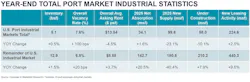
Rising costs in coastal logistics markets are contributing to the shift. Industrial rents in port markets climbed 65% between 2019 and 2023 and remain 33% higher than the national average, encouraging many occupiers—particularly those requiring facilities larger than 500,000 square feet—to pursue more cost-effective inland locations.
As a result, port markets recorded only 2% growth in industrial demand in 2025, compared with 21% growth across inland markets, reflecting a broader reconfiguration of supply-chain networks.
“Industrial occupiers are redesigning logistics networks around cost, resilience, and flexibility,” said Jason Price, Americas Head of Logistics & Industrial Research at Cushman & Wakefield, in a statement. “Port proximity remains important for speed-to-market and cross-dock functions, but large-scale distribution activity is increasingly shifting inland where occupiers can access lower costs, more land, and modern facilities.”
Trade policy and geopolitical tensions also reshaped global sourcing patterns in 2025. Imports from China fell roughly 30% year over year, while companies increasingly diversified production to Southeast Asia and Mexico to reduce tariff exposure and supply-chain risk.
Mexico remained the largest U.S. trading partner, exporting $534 billion in goods to the United States, with much of that cargo moving through land ports such as Laredo and El Paso before being distributed to regional logistics hubs. These shifts are helping drive industrial demand in inland corridors connected to cross-border trade and major population centers.
Looking ahead, Cushman & Wakefield expects industrial demand across many port markets to stabilize as development pipelines shrink and supply-chain strategies continue to evolve.
“Port markets remain strategically important, but investors and occupiers are becoming far more selective,” said Price, in a statement. “Building quality, infrastructure access, and proximity to population centers increasingly matter more than simply being located near a port.”
The report concludes that while trade policy uncertainty may create short-term volatility, the long-term fundamentals supporting industrial real estate demand remain intact, particularly for modern logistics facilities that support automation, AI-enabled operations, and high-throughput distribution.