Supply Chain Market Update: April

On April 23, ITS Logistics released its supply chain market update for 2026.
Here is an excerpt from the report.
Warehouse Capacity
March logistics activity accelerated meaningfully, with the overall LMI rising to 65.7 from 61.5 in February, a 4.2-point increase that signals broadbased expansion. Within warehousing, the market tightened as capacity declined from 50.0 to 46.0, moving from neutral into contraction.
Utilization eased slightly from 60.3 to 59.8, remaining expansionary but indicating that warehouse activity did not accelerate in line with overall demand. At the same time, warehousing prices increased from 62.1 to 67.4, reflecting renewed pricing pressure after moderating in February.
Inventory dynamics provide important context. Inventory levels increased only marginally from 53.8 to 54.8, suggesting that the acceleration in logistics activity is not being driven by a meaningful inventory rebuild. Inventory costs, however, surged from 67.8 to 76.2, a significant increase highlighting intensifying pressure on carrying costs despite relatively stable inventory volumes.
The data points to a system where demand is accelerating faster than capacity is adjusting, but without a corresponding increase in inventory levels or warehouse utilization. This indicates growing inefficiencies in inventory positioning and network flow, rather than a simple increase in volume.
With capacity tightening, pricing pressure rising, and costs spiking, the constraint is increasingly operational and structural, not just spatial. Competitive advantage will favor operators who can optimize network design, inventory placement, and throughput execution, rather than those relying on available capacity alone.
Truck Market Overview
All rates cited below exclude fuel surcharges, and load volume refers to loads moved unless otherwise noted.
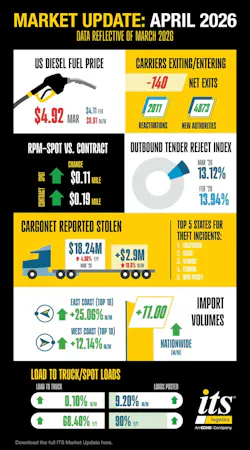
The March Logistics Managers’ Index (LMI) hit 65.7, the highest since May 2022, driven by a surge in Transportation Prices to 89.4—a 12.7-point jump.
This is tied to the Strait of Hormuz closure, pushing national diesel to $5.40/gallon and California’s to a record $7.60, with carriers quickly passing on the cost. The 50.2-point gap between transportation prices (89.4) and transportation capacity (39.2) is the widest positive inversion since November 2021, signaling a harder and more expensive market for finding trucks alone.
Unlike the 2022 freight boom, current inventories are lean (LMI Inventory Levels at 54.8 vs. 75.7 in 2022), leaving shippers with less buffer against disruption. Smaller firms are hit hardest; they report transportation price expansion of 92.7, much higher than the 84.6 for larger counterparts, with fuel surcharges acting as “tariffs 2.0.”
For carriers, while rates are the best in four years, high diesel costs are squeezing margins, especially for small fleets lacking long-term fuel contracts and contracted rate floors. The rising rates are often offset by fuel surcharges.
Twelve carriers over 100 employees filed Chapter 11 in March, signaling consolidation. However, tightening capacity (39.2) means growing pricing power for those who can withstand the cost pressure. Carriers should secure fuel surcharge agreements reflecting current diesel prices.
The forward LMI predicts that transportation prices will hit 93.0 in the next 12 months. Aggregate logistics costs are nearing the 240+ historical inflation threshold. With warehousing capacity contracting and transportation capacity at its tightest since September 2021, brokers face expensive spot exposure. Shippers must pivot from lean inventory to shoring up carrier networks and revising fuel surcharge language now to avoid painful Q2 rate resets.