CEO Confidence Takes a Dive in Q2

CEOs' confidence in the economy fell to 47 in Q2, down from 59 in Q1, according to The Conference Board's report released on May 28.
"CEOs reported that the economy is materially worse now than it was six months ago and expected economic conditions to weaken further over the next six months, " said Dana M Peterson, chief economist, The Conference Board, in a statement. "Regarding their own industries, CEO assessments about current conditions and expectations in six months deteriorated since last quarter.”
Roger W. Ferguson, Jr., vice chairman of The Business Council and Chair Emeritus of The Conference Board, said that planned business investment stayed the course in Q2, as most CEOs cited no revisions to capital investment plans.
"However, the share anticipating increases to capital spending plans in the next 12 months rose further, while fewer CEOs expect to reduce capex compared to Q1."
With regard to the workforce, Ferguson noted that the ‘low-hire, low-fire’ economy remains in place. The share of CEOs planning to increase the size of their workforce over the next 12 months edged down, while those expecting job cuts rose slightly. Plans for wage increases were overall little changed. Hiring qualified people was generally easier in Q2, but there was an uptick in CEOs who reported having ‘some difficulty in some areas."
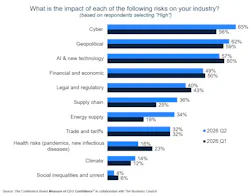
Regarding top business risks, Ferguson explained that "CEOs became more worried about cyber risks, with nearly two-thirds ranking it a top risk in Q2. Geopolitical and AI & new technology risks also remained top concerns. Risks associated with supply chains and energy rose in importance and intensity in Q2.”
AI Impact on Business
When asked what impact companies expected AI to have over the next two years, the answers were as follows:
Moderate impact-- many business processes will change, but the industry will not fundamentally transform -- 50%
Significant impact -- AI will affect nearly every business process: the industry will be fundamentally transformed -- 44%
Minimal impact -- Very few business processes will change; the industry remains largely unchanged.
Concerning AI workforce skills, respondents were asked what percentage of their workforce will need to be upskilled:
- 32% said that 10-25% will need to be upskilled
- 31% said 25-50% will need to be upskilled
- 24% said more than 50% will need to be upskilled
- 12% said that less than 10% will need to be upskilled