Autonomous Forklift for Trailer Loading and Unloading
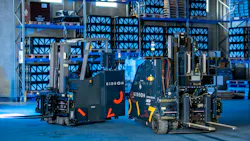
Gideon has introduced TREY, an autonomous forklift that can execute trailer loading and unloading from the first pallet to the last. It uses advanced physical AI technology to recognize and respond to variability on the dock.
Designed for warehouses that want to scale automation for large volume demand, the autonomous forklift performs at its peak on loading docks that receive 30 or more trailers per day. Its capabilities include:
Move up to 28 single- or double-stacked pallets or cages per hour, or 224 per eight-hour shift.
Identify and handle more than 119 load carrier types of different sizes and weights.
Work with various trailer styles ranging from dry van, refrigerated, drop deck, intermodal, and more.
Charge autonomously between cycles, extending operating time across multiple shifts.
Part of the autonomous trailer loading/unloading forklift category, TREY is an autonomous mobile robot (AMR) and is available in medium- and heavy-duty models to match the demands of manufacturing plants or warehouses. The heavy-duty model can move industrial parts and components with its payload of 6,000 pounds and operating time of 10 hours on one battery charge. The medium-duty model can carry a payload of 3,500 pounds and operate for 12 hours on one battery charge.
TREY operates on Gideon’s physical AI platform that combines image-based perception technology with sensor fusion to interpret its surroundings. The company’s vision module uses a two-camera stereoscopic system to gather depth information and provide context about objects in the path or perimeter of the forklift. Using neural networks, machine learning and its vision module, the automated forklift recognizes and responds to changing conditions during loading and unloading.