A Strategic Guide to Material Handling Fleet Management
Key Highlights
- Telematics and real-time data collection enable precise utilization tracking and operator accountability, reducing idle time and maintenance costs.
- Advanced safety systems like collision avoidance and zone-based speed controls significantly lower accident risks and equipment damage.
- Monitoring operator behavior with impact detection and AI analytics helps in targeted retraining and proactive risk management.
- Data fragmentation across multiple vendors hampers quick decision-making; a unified, manufacturer-agnostic data architecture is essential for efficiency.
- Implementing a centralized data platform simplifies IT management, standardizes metrics, and enhances fleet optimization, safety, and ROI.
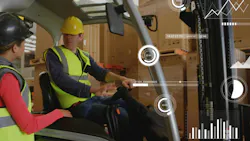
Managing a fleet of forklifts, pallet jacks, autonomous mobile robots (AMRs), and other material handling equipment (MHE) is absolutely critical to the efficiency and safety of any warehouse, distribution center, or industrial facility. Effective MHE fleet management moves far beyond simple maintenance schedules; it's an integrated, data-driven strategy aimed at maximizing productivity, enhancing safety, and rigorously controlling operational costs.
The Core Pillars of Modern Fleet Management
Modern material handling fleet management is built on leveraging technology and data insights to create a safer, more efficient work environment. It requires a commitment to three interconnected areas: data-driven utilization, advanced safety, and operator accountability.
Consider these core pillars:
1. Data-Driven Utilization and Telematics
In today's logistics environment, telematics is the indispensable backbone of efficient fleet management. Telematics solutions gather and transmit real-time data on every piece of equipment, transforming raw usage into actionable insights. They help companies:
Understand Usage: Telematics provides crystal clarity on which trucks are being used, when and for how long. This granular data allows managers to precisely identify underutilized equipment (candidates for removal or relocation) and overutilized equipment (requiring proactive maintenance). True utilization ensures assets aren’t sitting idle while new purchases are being approved.
Access Control and Accountability: By integrating operator identification (via PIN, badge, or biometric scanning), managers ensure only authorized and properly trained personnel operate specific vehicles. This accountability is a crucial first step in accident prevention and assigning responsibility for damage.
Manage Batteries and Fuel: For electric fleets, monitoring battery charge cycles and utilization prevents costly damage from improper charging habits (like opportunity charging), and ensures equipment is properly charged during off-peak hours, thereby avoiding interruptions during critical shift changes. For combustion fleets, it monitors idle time, providing critical data to reduce unnecessary fuel consumption.
2. Advanced Safety and Collision Avoidance
Safety is always a key concern in MHE fleet management, particularly where vehicles and pedestrians share workspaces. The implementation of advanced safety systems directly contributes to lower damage costs, reduced downtime and improved employee retention. Modern collision avoidance systems use technologies such as ultra-wideband (UWB) or radio frequency identification (RFID) to create exclusion zones or proximity alerts. These systems detect the presence of pedestrians, other vehicles or static obstacles, and issue timely warnings to the operator, and in some cases, automatically limit the vehicle’s speed or movement to prevent contact.
Speed management systems are also essential for regulating equipment velocity based on location. Indoor/outdoor or zone-based controls can automatically and safely reduce a forklift’s maximum speed when entering high-risk areas, such as intersections, narrow aisles, or pedestrian crossings.
Systems that can actively alert operators to a nearby person, or alert the pedestrian themselves, are vital for reducing the risk of a dangerous collision in busy material flow areas. Highly specific environments, such as very narrow aisle (VNA) racking systems, require specialized safety and anti-collision technology to prevent contact between vehicles or with the racking structure.
3. Operator Behavior and Impact Monitoring
Monitoring operator behavior is a direct, proactive way to reduce unexpected maintenance costs and increase vehicle longevity. Poor driving habits are a major contributor to damage and excessive wear. Impact detection systems added to the MHE use sensors to record and report sudden, excessive G-forces, indicating a collision or heavy impact. Managers can use the data from these impact detection systems to investigate incidents immediately and address operational risks.
More recent developments, including AI-impact detection systems, use video feeds and machine learning to analyze driving patterns and provide objective data. This can help identify habitual infractions like hard braking, excessive speed, or unauthorized access, enabling targeted retraining and accountability measures rather than relying on reactive reporting after an accident.
The Hidden Operational Tax: When Data Fails
Investing in these capabilities drives the essential shift from reactive or simple preventive maintenance to predictive maintenance, which achieves significant ROI through reduced direct costs and increased productivity. This entire strategy, however, hinges on one critical factor: a unified, accurate view of your fleet data.
Most large enterprises run mixed fleets for smart, practical reasons. Leveraging multiple vendors secures the best equipment for specific applications, maximizes procurement leverage, and prevents dependency on a single supplier. Yet, this intelligent strategy creates a massive data problem that directly undermines the core pillars of efficiency and safety previously discussed.
“What's our fleet utilization across all three distribution centers?” Imagine a VP needed that answer in five minutes. The painful reality for most operations is that it took days to manually pull, consolidate and interpret the data across different systems. This staggering time sink is the hidden operational tax of mixed fleet operations.
The Data Trap: Each manufacturer’s proprietary telematics system operates in isolation. Lift trucks report to different platforms depending on the brand, which means critical data is trapped in separate ecosystems. Worse, the very definition of a key metric like “utilization” can mean something entirely different in each system (e.g., one counting key-on time, another counting hydraulic usage).
Why The “Obvious Solutions” Don't Work
Leaders often attempt to solve this data fragmentation with two common, but deeply flawed, strategies:
Standardization on a Single Manufacturer: This sounds simple until you realize the monumental cost. It’s impossible to write off millions in functional, recently purchased equipment. Furthermore, no single brand truly excels at every application, and the transition would take a decade while eliminating a company’s procurement leverage.
Custom Integration Middleware: Developing custom APIs or middleware seems smarter, but it introduces unmanageable complexity. Manufacturer APIs change constantly, metric definitions never truly align, and the required continuous development, updating and maintenance become a permanent, expensive operational expense.
What's Actually Needed? A Unified Data Architecture
The solution isn’t to abandon the smart procurement decisions; it’s to fix the data infrastructure. That requires a unified data architecture where all trucks—regardless of manufacturer—report to one platform with standardized metrics.
This unified system must offer three critical, manufacturer-agnostic capabilities:
Manufacturer-Agnostic Hardware: Telematics devices that are purpose-built to work consistently across any brand of lift truck or MHE, providing a single data collection standard.
Single IT Integration Point: One centralized platform to manage and harmonize the data, instead of juggling multiple vendor connections and APIs. This dramatically simplifies IT overhead and security.
Objective Benchmarking: Standardized, clear and consistent metrics across the entire fleet so that fleet optimization, resource allocation and capital allocation become truly data-driven.
Maximizing ROI: The Business Case for Data Unity
When you can’t answer basic questions quickly, the business suffers significant, quantifiable losses. For example, fleet optimization opportunities remain invisible because utilization data is fragmented. The result? You keep over-purchasing equipment because you can’t prove that assets at one location are sitting idle while another location is running short.
Safety incident investigations require manually piecing together information across multiple, often incompatible platforms, which in turn delays accountability and risk mitigation efforts. And lastly, mitigating risks and improving data clarity helps companies realize a measurable return on investment (ROI) through reduced direct costs (lower insurance premiums, fewer workers’ compensation claims) and increased productivity (maximized equipment uptime). A workplace that visibly prioritizes safety through technological investment also significantly boosts employee retention.
The Bottom Line
You made smart procurement decisions to get the best tools for the job, but your current data infrastructure punishes you for it by imposing a massive operational tax. Only by adopting a unified, manufacturer-agnostic data architecture can you convert your complex, mixed fleet into a truly connected, intelligent system that delivers maximum efficiency and safety.
About the Author
 Alex Johns
Alex Johns
president
Alex Johns is president of ELOKON Group, an international provider of forklift telematics and safety solutions that enhance safety, efficiency and productivity in intralogistics operations.