If Forklifts Stop, America Stops
Key Highlights
- Skilled workers in logistics, maintenance, and technical trades are essential to keeping America's supply chain and infrastructure operational.
- Automation and advanced technology increase the importance of technical skills, critical thinking, and problem-solving in modern trades.
- There is a pressing need to raise awareness about skilled careers and expand workforce development programs to address labor shortages.
- The future of America's economy depends on a diverse range of career paths, including trades, technical professions, and traditional college education.
- Investing in apprenticeships and education will ensure the next generation can support the evolving systems that keep the country moving.
COMMENTARY & ANALYSIS
As America celebrates its 250th anniversary in 2026, many of the conversations have focused on our nation’s history. We’ve reflected on the leaders, innovators, entrepreneurs and visionaries who helped shape the country we know today.
Those stories deserve to be told. We got to where we are now by understanding what has allowed America to continually reinvent itself. We’ve seen progress turn an agricultural economy into an industrial economy; we’ve seen manufacturing turn into modern logistics; physical labor has changed into increasingly technology-enabled work. As we look back on the past 250 years, we should also look ahead and ask an important question: Who will keep America moving for the next 250 years?
The answer is not only in boardrooms, government offices, or technology hubs. It is also in warehouses, manufacturing plants, service trucks, construction sites, and communities across the country, where skilled workers show up every day to keep the economy running. America’s future depends on technological innovation and the people who make the physical systems work. People who can build, maintain, troubleshoot and adapt new systems as they are introduced.
I believe that if forklifts stop moving, America stops moving. Yes, forklifts are incredibly important, but they represent something so much bigger—the system and people that keep things moving. Material handling is critical for moving food through distribution centers, supplies through hospitals, products through manufacturing facilities, and goods onto store shelves. It is part of a broader system of logistics and infrastructure that most people do not think about until something breaks down.
It’s easy to think of infrastructure such as bridges, roadways, railroads, etc. But infrastructure also includes what moves goods through those systems. Material handling is the connection between different stages of the economy. It allows a product to move from a truck to a warehouse, from a warehouse to a production line, and eventually from a distribution center to a business or consumer.
Most people never take a second to think about the process. They order something online, find what they need on a store shelf, or receive a package at their front door. What they do not see is the network of people, equipment and facilities that made that delivery possible.
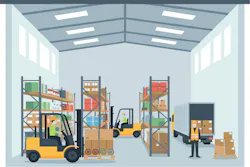
Picture a distribution center located in the middle of the country—a place most people never think about, let alone see. Every day, goods are delivered, organized, stocked and exported.
In that facility, every movement is part of a larger chain. A truck arrives with products that need to be unloaded. Those products need to be placed in the right location, retrieved when needed, loaded onto another truck and sent to their next destination. A delay at any one of those steps can create delays somewhere else in the supply chain.
What Would Happen If the Forklifts Stopped?
Now imagine if the forklifts stop. Within hours, incoming trucks can’t be unloaded at a proper speed. The weight of a single pallet couldn’t be moved by one person alone. Pallets that are loaded with perishable items would not make it to stores, hospitals, retail locations, etc. Stores would run low on stock, hospitals would be waiting on medications and supplies for days, and factories would halt because parts they needed didn’t arrive.
The idea behind “if forklifts stop moving, America stops moving” is about the fact that almost everything in daily life passes through a warehouse or distribution center. The machines doing the heavy lifting at these places are pivotal to keeping things moving.
More importantly, these machines, warehouses, distribution centers, etc., don’t run by themselves.
Behind every piece of industrial equipment is a skilled workforce of technicians, mechanics, operators, electricians, and logistics professionals whose work keeps businesses operating and supply chains functioning. Their jobs may not always be visible, but they are essential to how goods move through this country. They are part of the hidden workforce powering America.
Today, many industries are facing a challenge that is becoming increasingly difficult to ignore: a shortage of skilled workers entering the trades and technical professions. Experienced employees are retiring, demand continues to grow, and too few young people are entering the pipeline to replace them.
This is not a question of opportunity. These are strong, stable careers. The challenge is awareness. Too many students and families still see only a narrow definition of success, often centered on a traditional four-year college path. When parents and students hear the word “technician,” they might picture someone in a greasy warehouse doing repetitive manual labor. That isn’t always the case. Today’s skilled laborer can be working with sophisticated equipment, automation and digital diagnostics. A technician may spend part of a day diagnosing a problem with a piece of equipment, reviewing data, communicating with a customer and determining how to get a business back up and running.
A four-year college degree is the right path for many. But it is not the only path. America’s success also depends on mechanics, technicians, electricians, welders, operators, and other skilled professionals who keep our infrastructure and economy running.
A modern technician does more than install, inspect or repair equipment. They determine problems, evaluate data, maintain systems, identify inefficiencies, and find the right solutions. Ultimately, technical knowledge isn’t the only skill needed in a skilled trade profession; critical thinking and problem-solving are just as important.
In today’s world, technology is taking over; it will continue to change the way this specific work is done. Automation, electric equipment, connected systems and digital diagnostics are becoming increasingly common across warehouses and other facilities. But it will not remove the need for people to understand how these systems work. The more advanced technology becomes, the more important it is for skilled workers to be involved. In many cases, the more technology we introduce, the more important it becomes to have people who can understand, maintain and troubleshoot it. Equipment can provide information, but someone still needs to interpret that information and determine what actions should be taken.
These individuals are the people who connect what is happening in the warehouse with what the business needs to be successful. America would stop moving without them.
Throughout our nation’s history, progress has depended on people willing to solve problems, learn a trade, and do work that often goes unseen. From the shipbuilders and machinists who helped build our industrial foundation to today’s technicians supporting modern logistics and manufacturing, each generation has carried that responsibility forward.
The jobs may look different in the next 250 years, but the need for skilled laborers will remain the same. The equipment will change. The technology will change. The way we move goods will change. But one thing will remain the same: we will still need people who know how to build, operate, maintain and improve the systems that support our economy.
If we want America to remain strong over the next 250 years, I believe it is important to continue elevating skilled careers, strengthening workforce development programs, expanding apprenticeship opportunities, and helping young people understand the range of paths available to them.
This is not about choosing between college and the trades. It is about ensuring people know there are multiple paths that best fit their skills, interests and goals. America’s story has always been built by people who create, repair, transport, manufacture, innovate and solve problems. Their contributions may not always be visible, but they are fundamental to how this country functions. The hidden workforce powering America deserves greater awareness, continued investment, and long-term support as we look toward the next 250 years.
About the Author
 Tom Albero
Tom Albero
Chairman and CEO
Tom Albero is chairman of the board and CEO of Alliance Material Handling. He is responsible for leading the company’s overall strategy, operations and growth across its material handling and warehouse solutions business. He oversees organizational performance, supports business development initiatives, and works closely with leadership to support long-term company goals. Prior to joining Alliance Material Handling, he held positions with organizations including Enterprise Fleet Management and Intervise Consultants.