Yard Operations Are Suffering from Technology Fatigue
Key Highlights
- Many yards suffer from recurring issues like truck congestion, idle dock doors, and communication breakdowns, often addressed with quick fixes that fail to resolve root causes.
- A yard operating system (YOS) integrates data, processes, and assets to turn visibility into real-time orchestration, automating manual tasks and reducing congestion.
- Systemic solutions lead to significant ROI, including fleet reductions, lower detention costs, and sustainability gains, by aligning yard operations with broader supply chain strategies.
- In today’s environment, transforming yard operations is critical due to labor shortages, sustainability mandates, and rising customer expectations, making it the last frontier of supply chain optimization.
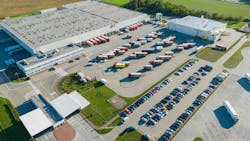
For decades, yards have been plagued by recurring headaches. Trucks stack up at gates. Trailers disappear into corners. Dock doors sit idle while drivers fume in detention. Spotters burn fuel circling the yard without clear direction.
Each pain point typically triggers a quick fix: add another radio, buy another trailer, authorize another overtime shift. More recently, the “pills” have changed labels. Instead of clipboards and extra labor, fixes now include gate sensors, scheduling apps, or tracking tools that promise visibility. Yet the headaches persist.
Treat the Causes, Not the Symptoms
Many enterprises fall into the trap of treating symptoms rather than root causes. They deploy a visibility tool and expect congestion to vanish. They add a scheduling app and assume dwell times will shrink. They install cameras at the gate, hoping data alone will eliminate inefficiency.
But visibility in isolation does not create flow. A dock scheduling app disconnected from live yard data simply shifts bottlenecks elsewhere. A trailer tracking solution does not resolve communication breakdowns between warehouse teams and drivers.
The result is technology fatigue: a cycle of investment in disconnected tools that never add up to transformative value. The yard remains just as chaotic, only now with more screens, alerts and dashboards.
This perspective aligns with the work of Lora Cecere, founder of consulting firm Supply Chain Insights, who has consistently warned that technology-first deployments fail when they are layered onto broken processes. Her research emphasizes that lasting improvement starts with disciplined operating models and process clarity, not tools alone.
From Management to Optimization
The distinction between management and optimization is critical. Traditional yard management, whether manual or supported by legacy yard management systems (YMS), focuses on daily execution at a single site. That may address immediate needs, but it does not create standardization, scalability, or network-wide resilience.
Optimization requires a shift in mindset. Organizations must stop viewing the yard as a local function and instead treat it as a strategic component of the broader supply chain network. That means:
· Standard operating procedures across sites.
· Consistent performance metrics and accountability.
· Integrated planning that connects the yard with transportation, warehouse and procurement functions.
This transition mirrors what happened in warehousing and transportation decades ago, when companies moved beyond standalone systems to integrated platforms. The yard is simply the last frontier.
Toward a Yard Operating System
The alternative to piecemeal fixes is a yard operating system (YOS): an integrated framework that unifies people, processes, assets and technology into a single orchestrated flow. A YOS is designed to move the yard from tactical firefighting to strategic value creation. It does so by:
· Turning visibility into orchestration: Data becomes decision-grade, driving real-time actions rather than static reports.
· Automating manual processes: Gate check-ins, dock assignments, and task allocation happen seamlessly and consistently.
· Converting congestion into throughput: Pre-registration, mobile driver apps and digital workflows reduce dwell times and paperwork.
· Optimizing spotter performance: Real-time tasking reduces empty runs, wasted fuel and unnecessary labor.
· Enhancing safety: Standardized protocols and automated alerts help prevent incidents.
· Unifying communication: Drivers, yard teams and warehouse staff operate from a shared playbook.
· Strengthening labor efficiency: Automation and training enable leaner teams to handle higher volumes without compromising service or safety.
Let’s take a closer look at why this matters.
The Business Case for Systemic Solutions
The costs of symptomatic fixes are easy to underestimate. Over time, they add up quickly through detention penalties, wasted fuel, lost salvage loads and strained carrier relationships. These inefficiencies erode profitability, damage service levels and strain already-tight labor pools.
Systemic reinvention, by contrast, produces measurable ROI. Enterprises that have embraced an operating system approach report:
· Double-digit fleet reductions through improved asset utilization.
· Significant cuts in detention costs from tighter gate and dock coordination.
· Hundreds of thousands of dollars in annual savings through better visibility and labor alignment.
· Sustainability gains from electrification, with each electric yard truck capable of saving tens of thousands of gallons of diesel and eliminating dozens of tons of carbon dioxide annually.
This pattern mirrors what McKinsey & Company has described in its article “A New Operating Model for a New World.” Rather than relying on isolated tools or localized fixes, McKinsey argues that meaningful performance gains come from redesigning how work flows across the organization. When operating models align people, processes and technology end to end, execution improves not incrementally, but structurally. The lesson for yard operations is clear: Without a coherent operating model, even the best technology will struggle to deliver lasting results.
These gains are not hypothetical. They are being realized today by organizations willing to stop treating the yard as a side concern and start treating it as a strategic lever.
Why This Matters Now
The yard has long been the forgotten link in supply chain modernization. Transportation and warehouse functions have benefited from decades of investment, while the yard has lagged. Today’s pressures are forcing that to change:
· Labor shortages are making overtime and manual workarounds unsustainable.
· Sustainability mandates are raising the cost of wasted fuel and emissions.
· Rising customer expectations demand more reliable service and fewer delays.
· Economic uncertainty is pushing organizations to extract more efficiency from their networks.
Analysts increasingly describe the yard as the last frontier of supply chain optimization. It is where inefficiencies accumulate and where the opportunity for ROI is among the highest. Companies that continue to rely on fragmented fixes risk falling behind on cost, compliance and service reliability.
From Pain Management to Systemic Health
Quick fixes provide temporary relief, but they do not address chronic conditions. For the yard to operate reliably and profitably, it must be treated as a system.
That requires:
· Consistency of process
· Disciplined execution
· Clear accountability
· Orchestration across all sites.
Reinvention of this kind moves the yard beyond pain management and establishes the foundation for long-term operational health.
The choice is simple: Keep reaching for another pill or invest in systemic health. The companies that choose the latter will set the standard for enterprise supply chain performance in the decade ahead.
About the Author
 Rafael Granato
Rafael Granato
vice president of marketing with YMX Logistics
Rafael Granato is vice president of marketing with YMX Logistics, a provider of end-to-end outsourced yard logistics.