Closing the Supply Chain Planning Value Gap

Supply chain organizations should stop placing the blame on planning technology when discovering that their investments in these technologies are not paying off, explains consulting firm Kearney, in a recent article. It’s not the technology, but the processes around it that are at fault, they say.
The authors, Hossein Naeini, Reza Beglary, and Gaurav Samant, provide this example.
A chemicals manufacturer deploys an advanced planning solution, investing heavily in customization to fit perceived business needs. But demand planners bypass the system’s native forecasting capabilities, relying instead on manual Excel files because they don’t trust the data quality. Supply planners face constant execution failures due to outdated material masters and incorrect capacity signals. Without a structured sales and operations execution (S&OE) cadence, there’s no weekly mechanism to align short-term plans with near-term execution. The platform technically functions, but it creates little actual value.
To ensure value is derived from the software solution, the authors note that leading organizations are now conducting capability and maturity assessments. These “fact-based evaluations establish exactly where planning processes, data, systems, and organizational practices stand today, and what specific gaps must be closed before a planning solution can live up to its promise.”
The assessment follows this structure.
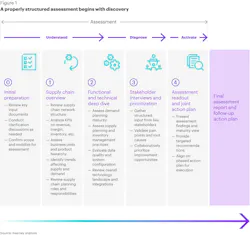
When doing a diagnosis, the authors recommend looking at the following areas:
Process maturity examines whether planning operates as an integrated, concurrent system or as a series of disconnected handoffs.
Organizational design and governance probes whether roles, responsibilities, and decision rights match a modern planning model.
Metrics and outcomes connect planning performance to business results.
Data and systems architecture evaluates whether the planning platform is properly configured, and data flows support actual decision-making.
Solution design choices often emerge as a major factor in why planning platforms fail to deliver expected value.