Navigating the Complexities of High-Mix Distribution with AMRs
Key Highlights
- Plan for SKU variability from the outset by establishing regular reconfiguration cycles to keep the AMR system aligned with changing product mixes.
- Define explicit prioritization protocols for handling competing client demands, including decision authority and escalation procedures, to prevent operational crises.
- Verify all data inputs—item masters, SKU records, inventory locations—against the physical environment before deployment to avoid persistent errors.
- Assess and modify the physical layout, such as aisle widths and staging areas, to optimize navigation and workflow efficiency for autonomous robots.
- Design the deployment architecture to accommodate future growth and operational changes, ensuring sustained performance without degradation.
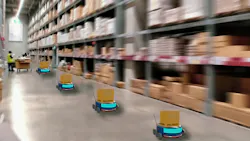
As autonomous mobile robot (AMR) technology becomes mainstream in distribution operations, a pattern is emerging that the industry has been slow to acknowledge. The deployments that go well tend to share the same profile: one client, stable volumes, a product mix that changes little from week to week, and a floor designed around a single clear set of operational requirements.
Whereas the deployments that struggle also tend to share a profile: multiple clients, SKUs that keep changing, competing priorities placing simultaneous demands on the same robot fleet, and a floor that was never really designed for anyone.
The robots in both scenarios are often identical. What separates the outcomes is not the hardware, but whether the organization deploying it genuinely understood the environment they were walking into, or applied an approach designed for a simpler operation and hoped the results would follow.
A Different Environment Requires a Different Approach
Most AMR deployments are designed with a single-client environment in mind: stable SKU profiles, predictable volumes, a floor built around one set of requirements, and a WMS feeding clean, consistent data to the robot fleet.
In the case of a high-mix distribution facility, it’s not one operation running under one roof. It’s several distinct operations sharing the same floor, the same equipment and the same robot fleet, each with its own product profile, its own demand patterns, and its own contractual expectations. Each client is effectively having its own deployment problem, and a single AMR configuration cannot serve all of them equally well.
Challenge 1—Variable SKU Profiles
AMRs perform well when the environment matches what they were configured for.
In a high-mix distribution environment, that match rarely holds for long. SKU profiles shift constantly with new clients, new seasons and new contracts. A robot fleet calibrated for today’s product mix may be poorly suited to what is moving through the facility months from now. New items create navigation conflicts. New handling requirements disrupt task logic that was working fine before they arrived.
What follows is not a breakdown, but a slow drift between the system’s original configuration and the operation it now supports. One thing that needs to be acknowledged is that the product mix varies and will continue to change, and the AMR system needs to change with it. Building regular reconfiguration cycles into the operational model from the beginning is what keeps the system performing against current reality, rather than a snapshot of what the facility looked like on day one.
Challenge 2—Competing Client Priorities
Task prioritization in a single-client warehouse is straightforward: one set of priorities, one SLA framework, one team deciding what matters most. In a high-mix environment, that simplicity disappears entirely.
Most AMR systems have prioritization logic built in. But when multiple clients simultaneously place demands on the same robot fleet, the system faces a question it wasn't designed to answer: whose work comes first?
For instance, one client needs an urgent outbound shipment, while another has inbound volume backing up at the dock. Both scenarios are time sensitive. The decision becomes a human judgment call rather than a system-driven one because what most AMR systems lack is the ability to weigh the contractual history, relationship context and operational nuance that determines which client should genuinely take precedence in each moment.
The practical response is to make those decisions in advance, ensuring all scenarios are considered before robots go live, rather than in the middle of a shift when the pressure is highest. Building explicit prioritization protocols into the deployment plan by clearly defining, for each client and each type of scenario, how competing demands will be handled and who has the authority to intervene will turn a recurring operational crisis into a managed process.
Challenge 3—Data Inconsistency
One of the most common failure modes in high-mix AMR deployments is also one of the easiest to misdiagnose. The robots are operational, and tasks are being assigned and completed, yet errors keep surfacing such as wrong locations, mishandled items, robots arriving at positions that turn out to be empty or inaccessible.
The initial instinct is to investigate the technology, but in most cases, the problem is the data feeding it, not the technology itself.
Each client in a high-mix environment brings their own item master, their own SKU dimension records, their own inventory naming conventions, and their own update frequencies. All of it flows into a single warehouse management system that the robot fleet depends on, and inconsistencies between those data streams create quiet, persistent errors that are easy to attribute to the wrong cause. The robots were doing exactly what they were instructed to do. The instructions themselves were wrong.
Addressing this before deployment is a prerequisite, as every location record, every SKU dimension, and every inventory position the robot fleet will act on needs to be confirmed against what exists on the floor before the first task is assigned. The time that verification takes is considerably less than the time that will be spent untangling data-driven errors after go-live.
Challenge 4—Legacy Floor Layouts
Most high-mix distribution facilities were not designed with autonomous mobile robots in mind. They are existing buildings that have been reconfigured over time such as walls moved, racking added, staging areas shifted to accommodate whatever the operation needed at the time. The result is a floor that reflects years of pragmatic decisions rather than any single, coherent operational logic.
Walking that floor before a deployment, and walking it through the lens of robot navigation, are two very different experiences. Aisle widths that feel adequate for a human workforce create clearance problems for a robot fleet operating at full throughput. Storage configurations are shaped by clients who left the building but still influence how the current operation runs. Staging areas sit where space happened to be available when they were first established, not where they would make the most sense for an automated workflow moving efficiently between receiving, storage and dispatch.
Treating the physical environment as part of the deployment scope, rather than a fixed condition to work around after go-live, changes this entirely. Widening a specific aisle, relocating a staging area that creates a consistent bottleneck, and updating floor markings that have grown inconsistent over years of repainting are not major capital projects, but their impact on robot performance is disproportionate to their cost, and they're almost always faster and cheaper to address before the robots arrive than after.
Challenge 5—Scalability
High-mix operations rarely struggle because something went wrong at go-live. They struggle because the operation keeps evolving, and the AMR configuration doesn’t.
New clients arrive mid-year with product profiles nobody planned for. Existing clients grow or shrink. Seasonal peaks push volume well beyond what the system was set up to handle, then drop away just as quickly. Together, they add up to an operation that can look very different from the one the robots were originally configured for, sometimes within months of deployment.
Most systems can accommodate growth, but doing so without degrading existing workflows requires deployment architecture designed for variability from the beginning. Organizations that treat their initial configuration as a finished product consistently find that performance plateaus well below where it should be, not because the technology reached its limit, but because the configuration stopped keeping pace with the operation it was supposed to serve.
What High-Mix AMR Deployment Actually Requires
The challenges described above are not reasons to avoid automating a high-mix distribution environment. They are reasons to go in better prepared than most organizations do.
Operations that get this right tend to share a few common habits:
• Treat SKU variability as something to plan for from day one, rather than react to after go-live.
• Decide in advance how competing client demands will be handled, and who has the authority to make that call in real time, rather than leaving it to whoever happens to be closest to the problem.
• Verify the data against physical reality before the first robot moves, rather than discovering inconsistencies through operational errors.
• Design the floor layout to prepare for automation, rather than work around it after the fact.
• Configure the system for the operation they expect to be running, not just the one they have today.
High-mix distribution environments are demanding. They’re also the environments where automation has the most to offer, because the complexity that makes them hard to automate is exactly the complexity that makes them expensive to run manually. In my experience, it’s consistently left on the table because the preparation wasn’t thorough enough. The operations getting the most from their AMR investments aren’t the ones with the best robots. They’re the ones that did the harder, less visible work before the robots ever arrived.
About the Author
 Sahil Phale
Sahil Phale
industrial engineer
Sahil Phale is an industrial engineer at Yusen Logistics, a supply chain and third-party logistics provider (3PL), with expertise in leading automation initiatives, driving process improvements, and delivering operational efficiency gains across large-scale distribution and manufacturing environments by combining data analytics and decision-making frameworks to drive measurable results. As a Certified Supply Chain Manager and Certified Six Sigma Green Belt, he applies structured methodology to automation challenges that most organizations approach without a framework.