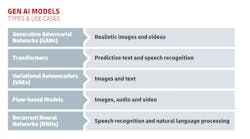
Generative AI in Supply Chain
Supply chain managers have increased their usage of Generative AI. In fact, MH&L reported that the majority of shippers are already using this technology.
A Descartes survey found that 96% of overall respondents indicated they are using it within their operations, with the top three use cases cited as data entry (41%), route/load optimization (39%), and AI-driven freight forecasting and automated load matching/capacity sourcing (both 35%).
This technology differs from AI in general is that Gen AI can "read procedures originally written for human workers and execute the work described in many use cases. When the procedures require decisions and reasoning to succeed, the Gen AI becomes what’s called Agentic AI," according to a recent DHL article.
While traditional AI can produce predictions by leveraging structured data, Gen AI uses language and image models trained on larger datasets. This gives it the ability to create new artifacts, including text, images, code, simulations and other content.
For the supply chain, DLH points out that in the supply chain and procurement domain, this means:
-
Generating demand scenarios (e.g., “What happens if demand doubles in Q3 because of a regional promotion?”) rather than only estimating a point forecast.
-
Generating or drafting communications.
-
It provides interactive intelligence every step of the way.
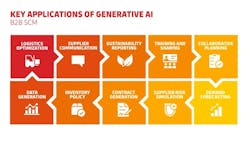
The article notes three ways companies are using generative AI in supply chain flow.
1. Forecasting & predictive demand
Generative AI models take in historical demand data to generate scenario ranges for future demand.
2. Customs compliance automation & shipping intelligence
Customs, duties, import and export regulations, and shipment visibility are still bottlenecks and sources of cost. Generative AI automates parts of customs documentation, HS and HTS code classification checks, route-risk assessment, and shipment intelligence.
3. Buyer, supplier & partner communications (onboarding, procurement)
Generative AI automates and accelerates communication flows in procurement and in supplier and partner ecosystems. Use cases include supplier onboarding, buyer queries, and contract drafting.
Challenges of Gen AI
As is the case with any iteration of technology, there are issues. DHL points out the following concerns:
- Data quality and integration: Generative AI is only as good as the data feeding it. Procurement systems often have fragmented or low-quality data, which hinders outcomes.
- Trust and transparency: If the system generates recommendations or decisions, such as new routing or supplier onboarding, there must be human-in-the-loop oversight and auditability.
- Model risk and “hallucination”: Generative AI models may produce plausible-looking but incorrect outputs; guardrails, validation, and clear escalation paths are essential.
- Change management: Embedding new ways of working, such as chatbots for suppliers and AI-driven forecasting, requires culture change in logistics and procurement teams.