Last Mile Logistics Software Market to Double by 2032

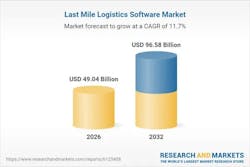
The significant growth trajectory of the last mile logistics software market is a direct result of accelerating e-commerce and consumer expectations. In a new report from ResearchandMarkets, the market will increase from $44.45 billion in 2025 to $49.04 billion in 2026.
It's expected to hit $96.58 billion by 2032.
A compounded annual growth rate (AGR) of 11.72% is attributed to escalating delivery network intricacies, technological advancements, and rising compliance demands. The growth rates suggest a strong sectoral focus on delivering reliable customer experiences and ensuring efficient resource use in fulfillment strategies, the report notes.
Scope & Segmentation
-
Component: Core platforms offer features like orchestration, dispatch, routing, and proof of delivery, complemented by integrated services for deployment, training, and operational support.
-
Deployment Mode: While cloud solutions provide agility and seamless integration, on-premises systems cater to data residency and compatibility needs.
-
Organization Size: Large enterprises emphasize governance and scalable workflows, whereas small and mid-sized firms prioritize implementation speed and cost reduction.
-
End User: Retailers focus on brand engagement, logistics firms on service and coordination, carriers on flexible configurations, and third-party logistics on billing and controls.
-
Application: Platforms for same-day and on-demand services enhance dispatch and exception handling; B2B solutions focus on scheduling and compliance.
-
Industry Vertical: Requirements range from advanced controls in grocery logistics to data privacy in healthcare, with manufacturing and field services needing efficient scheduling and visibility.
-
Region: Market dynamics vary, from supply chain integration in the Americas to emission compliance in Europe, necessitating tailored approaches for each region's challenges and opportunities.
-
Technology: Technologies like AI, hybrid fleet management, and real-time analytics enhance decision-making and operational efficiency.
Key Takeaways
-
Last-mile logistics software centralizes order management, routing, dispatch, and communication, forming a comprehensive operational framework.
-
AI and machine learning facilitate efficient resource allocation and predictive delivery management, optimizing scheduling under actual conditions.
-
Hybrid fleet strategies and multi-carrier integrations are becoming industry standards, focusing on sustainability and service consistency.
-
Sustainability and regulatory adherence drive new software features, supporting emissions tracking and improved logistical controls.
-
The diversity of regional logistics challenges demands customized software solutions for scalable and reliable delivery outcomes.