Technology Integration Blocking Scaling Supply Chain AI

In a survey of 140 senior supply chain leaders from organizations with annual revenues of $250 million or more from October to November, 2025, Garnter found that 56% of chief supply chain officers (CSCOs) say integrating AI with legacy systems and processes is a major challenge. The top reasons for the challenge are due to limited internal expertise or talent to implement and manage AI.
“The pressure to demonstrate quick results often leads supply chain leaders to settle for AI as a tool for incremental improvements to legacy workflows,” said Snigdha Dewal, director analyst in Gartner's supply chain practice in a statement.
“However, our research shows that the greatest friction point in scaling AI today isn't the technology itself, but the legacy environments in which it is being deployed.”
Gartner defines an AI-native supply chain as a supply chain operating model that is designed from the ground up to leverage AI, rather than simply adding AI-driven functionality to existing, traditional workflows.
“Bolting AI onto an analog-era foundation only locks in existing inefficiencies and yields local optimizations,” added Dewal. “Leading CSCOs are reimagining the supply chain operating model, associated team roles and the supporting technology layer to build AI-native supply chains.”
The AI-Native Supply Chain
The survey identified a group of “AI leaders” that are actively trying to scale AI across their supply chains and are developing advanced AI capabilities. These leaders are also seeing above average returns from their AI investments.
Early lessons from these leaders show that investing in AI means the tech-adjacent organizational layers will also need to evolve. To successfully put themselves on the path to an AI-native future, today’s CSCOs will need to transform their supply chains in three important areas
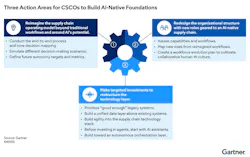
Action Areas for CSCOs to Build AI-Native Foundations
Reimagine the Supply Chain Operating Model: AI leaders are moving beyond using AI to optimize existing processes, instead reimagining entire operating models around AI-driven workflows. By redesigning end-to-end processes now, leaders are also modeling how decision-making processes will change and determining the right level of autonomy for the future.
Redesign the Organizational Structure: Leading CSCOs are redesigning organizational structures by retiring legacy roles, creating AI-centric positions, and evolving job models. Instead of bolting AI onto existing roles, they are defining new, flexible roles aligned to AI-driven workflows that expand human impact and unlock the full value of AI.
Restructure the Technology Layer: Leaders should deliberately evolve—rather than replace—their tech stacks, building a unified data layer and agentic layer that sits atop legacy systems. The desired future state should be an agile, composable architecture that can independently and iteratively evolve with new business requirements. This process will need to establish AI governance and safeguards in parallel, to support responsible scaling and mitigate data security risks.