How to Optimize Warehouse Storage Design for Maximum Efficiency
Key Highlights
- Optimizing warehouse space is crucial for maximizing profitability and productivity.
- U-shaped and I-shaped layouts, vertical space utilization, and dynamic storage enhance workflow and storage capacity.
- Achieving maximum efficiency requires careful planning, consideration of material handling equipment, and potentially integrating robots and professional design services.
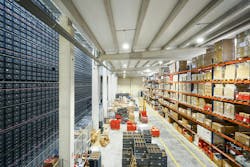
The most profitable warehouses make every square foot count. Space optimization is a science, and the managers who understand which principles work and which ones do not can unlock new levels of efficiency and productivity. Leading providers of warehouse storage design services swear by these strategies to handle more cargo and fulfill more orders quickly.
Maximize Vertical Space
Verticality is the key to fully utilizing your facility’s storage capacity. The most common approach is to extend rack heights as much as possible. It should not pose any safety risk, provided that there is enough clearance between the top load and the lowest overhead obstructions. The 2022 edition of NFPA 13, the standard for sprinkler system installation, requires 6 inches of flue space around each pallet load within multiple rows of open racks.
Building mezzanines is another proven way to maximize vertical warehouse space. These freestanding elevated platforms can double your property’s usable floor space for lighter load storage without budgeting for costly building expansions and scheduling considerable downtime due to installation. Support columns can interfere with material handling, so consider forklift paths when designing mezzanines.
Adopt a U- or I-Shaped Layout
The U-shaped layout places the receiving and shipping bays adjacent to each other, and storage occupies the back of the warehouse. This design promises more flexibility, supports cross-docking capabilities and simplifies returns management. It is ideal for smaller buildings and should not cause truck congestion as long as you space the bays far enough apart.
The I-shaped layout forms a straight line, with the receiving and shipping bays at opposite ends, sandwiching the storage area. The linear flow of goods enables you to handle higher order volumes. Warehouse storage design service providers recommend this layout for larger facilities.
Reduce Aisle Width
Narrower aisles create more storage space. However, standard-sized material handling equipment cannot safely navigate through tighter passages. Reduced aisle width requires the use of compact vehicles to transport merchandise in a high-density racking layout.
Articulated forklifts fit the bill. These versatile vehicles use different attachments to handle various load types — including oversized and long loads — in confined areas and move cargo between the rack and trailer at fast speeds.
Embrace Dynamic Storage
Dynamic racking is about filling any available space with items rather than rigidly reserving locations for specific products. This inventory system suits facilities with narrow aisles because gravity aids the flow of merchandise from the restocking side to the picking side. Pallet flow, push-back and carton flow racks support dynamic storage.
Warehouse design service providers acknowledge that dynamic storage is suitable only for high-turnover goods. High volumes of stale or slow-moving merchandise can clog the system. Fluid item arrangement can be challenging to track, but a robust warehouse management system should make it effortless to locate specific products at any given time with minimal staff.
Employ Robots
Warehouses cannot function efficiently when highly dependent on manual labor. Human workers should coexist with industrial machines to reap the efficiency gains of optimal warehouse storage. Integrating robots into warehouse operations can be capital-intensive, so incorporate machines that are proportional to your facility’s size to boost productivity and break even faster.
Draw inspiration from microfulfillment facilities. Smaller sites with cubic storage grids use rack-climbing bots that can pack up to 600 bins per 1,000 square feet. Meanwhile, mega-hubs automate using stacker cranes, whose volume capacity can justify their 20-year payback windows.
How Fairchild Equipment Optimizes Warehouse Design
Fairchild Equipment, an established warehouse storage design service provider near Milwaukee, analyzes a facility’s space and the types of products it handles to determine the most efficient racking layout. The company uses its expertise in warehouse engineering design and a broad selection of industrial equipment to create storage and material handling systems and pair them with corresponding robots, such as automated guided vehicles, to achieve rapid, accurate fulfillment rates and maximum uptime.
Achieve Maximum Efficiency With Optimal Warehouse Storage
These strategies contribute to warehouse storage optimization. However, determining the most efficient layout requires careful consideration. Hiring a professional warehouse storage design service provider is essential to avoid costly mistakes and achieve your productivity and profitability goals.
Frequently Asked Questions
Here are the answers to common questions about warehouse storage.
What Is the Main Purpose of Storage in a Warehouse?
The main purpose of warehouse storage is to house goods securely, safely and efficiently to prevent injury and property damage until needed for shipment.
What Is the Primary Concern When Designing a Storage Layout in a Warehouse?
The primary concern in designing a warehouse storage layout is balancing space utilization and workflow efficiency.
What Are the Different Types of Storage in a Warehouse?
Pallet racking, mezzanine flooring, static shelving, and vertical and horizontal carousels are common types of warehouse storage.
This content is sponsored by: