Beyond Route-Based Sequencing: How AI Sifts Millions of Combinations to Build Smarter Pallet Assignments
Key Highlights
- Assignment intelligence becomes strategically important. It can sit above existing processes and help orchestrate work more effectively across whatever environment exists today,
- The impact of better assignment logic is not theoretical. One of the largest wholesale grocery cooperatives in the U.S. used intelligent pallet matching across its network to reduce picker travel by 15–30%, with an additional 5–15% savings from optimized pick paths
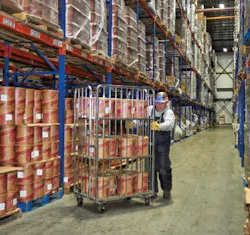
Most warehouse management systems (WMS) assign work based on delivery logic, route number, stop sequence, store priority. That makes sense for loading trailers. But it creates a massive blind spot: nobody's optimizing how the work gets picked.
A picker with a double pallet jack gets two pallets. In a route-based system, those two pallets share a delivery route, but their pick locations might be scattered across 12 different aisles. Meanwhile, there's another pallet in the queue whose picks overlap almost perfectly with Pallet A… but it's on a different route, so the WMS never considers pairing them.
Multiply that missed opportunity across hundreds of assignments per shift, and you're looking at thousands of unnecessary aisle traversals every single day.
The Hidden Complexity Inside Every Pallet Assignment
The opportunity is to move beyond a single sequencing rule and treat pallet assignment as a real-time optimization problem. Rather than asking only whether two pallets belong to the same route, an intelligent assignment model can evaluate which pallets should be picked together based on where the work actually occurs in the building.
That means considering millions of possible pallet combinations in the moment work is requested, then identifying the pairing that reduces travel while still respecting operational constraints such as load balance, product compatibility, order priority and delivery deadlines.
The worker is not being asked to change the fundamentals of the job. They are still picking, building pallets and serving the same stores. The difference is that the assignment logic is designed around the physical reality of the pick path, not just the downstream needs of the trailer.
Why Travel Reduction Is Often the Fastest Path to Productivity
The impact of better assignment logic is not theoretical. One of the largest wholesale grocery cooperatives in the U.S. used intelligent pallet matching across its network to reduce picker travel by 15–30%, with an additional 5–15% savings from optimized pick paths. The result was approximately $5 million in annual savings.
A similar pattern is emerging in other large food distribution environments. Another major U.S. food wholesaler, representing more than 1,000 member companies and more than $12 billion in sales, projected an 18% reduction in on-floor worker travel time, an 8% productivity gain and roughly $1 million in monthly savings. Just as important, those gains were tied to software-driven work optimization rather than a major fixed automation investment.
The New Economics of Warehouse Improvement
This matters because the economics of warehouse improvement are changing. Labor remains difficult to find and retain, capital spending is under greater scrutiny, and most distribution centers now operate in mixed environments where manual processes, automation and legacy systems all coexist.
In that environment, the question is not simply how to automate more tasks. It is how to make every existing movement, decision and assignment more productive. Fixed automation can be transformational in the right setting, but it is not always the fastest or most flexible path to improvement. Many facilities need gains that can be achieved without rebuilding the operation around a single physical design.
That is where assignment intelligence becomes strategically important. It can sit above existing processes and help orchestrate work more effectively across whatever environment exists today, including manual zones, automated zones, fully staffed shifts, short-staffed shifts and processes that still depend heavily on local knowledge.
The More Practical Future: Augmenting the Workforce
For years, much of the warehouse technology conversation has centered on replacing labor with automation. In some operations, that is the right long-term direction. But for many facilities, the more immediate and broadly applicable opportunity is to augment the workforce by removing unnecessary movement, reducing decision complexity and giving employees better assignments from the start.
This is a different framing of productivity. Intelligent algorithms can evaluate combinations and tradeoffs that no human planner can process at operational speed. Workers bring the physical execution, judgment and adaptability required on the floor. When the two are aligned, the result is not simply faster picking; it is a more efficient operating model built around better use of human effort.
In other words, the goal is not to push people harder. It is to stop asking them to spend so much of the shift walking between poorly matched work.
From Optimization Theory to Operational Practice
The broader lesson is that meaningful productivity gains do not always require a forklift upgrade of the entire operation. In many cases, the starting point is better visibility into the building, better use of historical and real-time order data, and a willingness to challenge the sequencing rules that have long been treated as fixed.
A practical approach usually begins with mapping the facility, analyzing actual order patterns and simulating how different assignment strategies would change travel. That makes it possible to quantify the opportunity before making broad operational changes. Once the model is in place, workers begin receiving assignments that reflect a more complete view of the work in front of them.
Because the improvement is driven by assignment logic rather than physical infrastructure, the feedback loop can be much faster. Operations can test, measure and refine the model in weeks rather than waiting for a major capital project to reach completion.
The Next Productivity Frontier Is Between the Picks
Traditional WMS logic was designed to manage inventory, fulfill orders and support downstream delivery requirements. It was not built to solve the more dynamic question of which pallets a specific worker, using specific equipment, should pick together at a specific moment based on where the work sits across the facility.
That distinction matters. As warehouses look for ways to improve throughput without simply adding labor or committing to large-scale automation, the space between picks becomes one of the most valuable areas to examine. Every unnecessary aisle traversal is a small inefficiency. Across hundreds of workers, thousands of assignments and millions of cases, those small inefficiencies become a significant cost.
The larger lesson is not that one technology category will solve every warehouse challenge. It is that the next wave of productivity improvement will come from making better decisions at the point where work is assigned. The savings are often already present in the operation. They are hidden in the distance workers travel, the combinations systems overlook and the assumptions embedded in legacy sequencing rules.
About the Author
 Evan Danis
Evan Danis
Evan Danis, Corporate Marketing Manager, Lucas Systems
Danis is a seasoned marketing professional with extensive experience in corporate communications and content management. Currently serving as the Corporate Marketing Manager at Lucas Systems since March 2022, Evan develops targeted advertising strategies and promotional content.