Collaborative Robots Use Increases in Warehouses
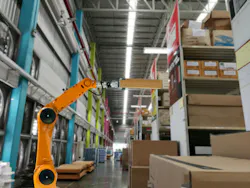
Companies are increasing automation in warehouse configurations by automating intralogistics. They are achieving this by adopting collaborative mobile-manipulator robots. These systems use a self-navigating base with a collaborative robotic arm. And this arm can transport, pick and place items.
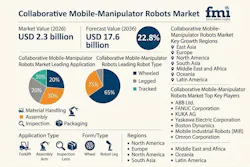
The size of this market reflects the pace of change. Valued at $2.3 billion in 2026, it is projected to expand to $17.6 billion by 2036, a 22.8% CAGR, according to Future Market Insights (FMI).
One of the major drivers of this growth is continuing labor shortages in warehouse operations.
One reason for the fast growth of this technology is the ability of AI to increase the value of the robotic arms. An article published by the Association of Advancing Automation (A3) last year noted that "AI is the element that elevates a mobile manipulator from a remote-controlled arm on wheels to a valued worker that can move and act with purpose."
However, it's not a simple application, according to the article, as technical integration between AMRs and traditional robot arms must be addressed.
“Because traditional robot arms and AMRs grew up as separate industries, the technical integration between the two has been a challenge,” says Jeremy Rockman, head of product development, robots, Mobile Industrial Robots (MiR), in the article. “Most mobile manipulators require that two different companies with two different tech stacks collaborate to create this new capability. Controls and software integration is where most of the hurdles need to be addressed.”
About the Author
 Adrienne Selko
Adrienne Selko
Senior Editor
http://mhlnews.com
Adrienne Selko is also the senior editor of EHS Today and a former senior editor of IndustryWeek.