Half of New Warehouses Will Be Human-Optional by 2030
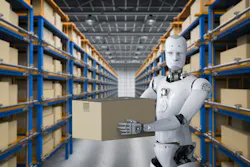
Automation in warehouses has expanded greatly over the years. But by 2030, they will be front and center. By 2030, 50% of new warehouses in developed markets will be designed as “robot-centric” facilities, with humans being optional, according to Gartner, Inc., a business and technology insights company.
As warehouse workers become less willing to perform manual tasks, many organizations will be challenged to sustain operations through hiring alone, as labor costs and labor supply remain under significant pressure for most of the year. In response, chief supply chain officers (CSCOs) are accelerating adoption of intralogistics smart robotics (ISRs) to scale operations as manual labor warehouse models become increasingly obsolete.
“AI continuously optimizes warehouse environments in real-time, shifting them from static structures into agile systems that adapt as demand changes,” said Abdil Tunca, senior principal analyst in Gartner's supply chain practice, in a statement.
“This changes how CSCOs think about designing warehouses for scalability, from settings that primarily rely on human labor to environments that maximize the ability to orchestrate robotic fleets.”
The ISR market is highly fragmented and will require most companies to adopt more than one type of robot and a multiagent orchestration platform to coordinate heterogenous fleets of robots. As robot adoption accelerates, organizations are moving beyond retrofitting traditional facilities with automation to designing new warehouse environments. In these modern warehouses, human labor is required only for exception handling, rather than serving as the foundation of daily operations.
Workforce and Cost Pressures Are Driving a Shift to AI‑Orchestrated Operations
Warehouse designs will increasingly prioritize flexibility, efficiency and adaptability to support automation-led, human-aided workflows. Workstations, storage of goods and fulfillment workflows can be adjusted instantly based on changes in demand patterns or labor availability, allowing facilities to respond without costly physical redesigns
Over time, fixed warehouse infrastructure will give way to more software‑managed environments that continuously self‑optimize. For example, rerouting robotic pickers to higher‑priority orders during peak demand or reallocating tasks between humans and machines when staffing levels fluctuate.
This shift enables organizations to scale operations more efficiently. Autonomous facilities can operate with reduced lighting and climate requirements and reconfigure workflows without physical infrastructure changes. While there will be upfront capital costs, automation offers structural cost advantages that can help organizations handle higher order volumes with lower costs.
Gartner recommends CSCOs take the following steps when designing robot‑centric warehouse environments:
-
Adopt digital twin and simulation models early to validate layouts and optimize robotic performance prior to construction.
-
Favor scalable, software‑defined robotics platforms over single‑purpose automation to improve adaptability and reduce obsolescence risk.
-
Establish long‑term vendor ecosystem partnerships to support future integration, flexibility and expansion.