Warehouse Automation Driving RaaS Market
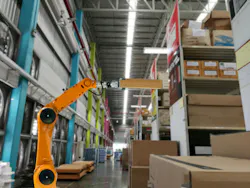
The Robotics as a Service (RaaS) market is expanding rapidly as organizations increasingly adopt subscription-based robotic solutions to improve operational efficiency without making substantial capital investments.
The market is experiencing significant transformation through the rapid adoption of artificial intelligence, machine learning, autonomous navigation, and cloud robotics.
More than 4.3 million industrial robots were operating worldwide by 2025, creating strong demand for cloud-enabled robotic management platforms, according to a report from Business Research Insights.
Approximately 61% of logistics providers have integrated autonomous mobile robots into warehouse operations, reducing manual handling activities and improving inventory movement.
Warehouse automation accounts for approximately 39% of RaaS deployments, while autonomous mobile robots represent nearly 34% of installed service robots, supporting continuous market expansion across multiple industries.
The United States represents one of the largest adopters of RaaS), supported by widespread automation across manufacturing, healthcare, logistics, and retail industries. More than 420,000 industrial robots operate across U.S. manufacturing facilities, while over 78% of large distribution centers utilize robotic automation for warehouse operations.
Approximately 61% of healthcare providers have implemented robotic-assisted solutions for logistics, sterilization, or patient support.
Technology Advances
More than 68% of newly introduced robotic systems now include AI-enabled decision-making capabilities that improve route planning, obstacle avoidance, and task scheduling.
Cloud connectivity is now available in nearly 74% of commercial RaaS deployments, enabling remote monitoring, software updates, predictive maintenance, and centralized fleet management.
Collaborative robots continue gaining popularity, accounting for nearly 29% of newly deployed robotic platforms across industrial environments.
Around 57% of manufacturers now favor flexible robotic subscription services rather than purchasing equipment outright, allowing easier scaling according to production requirements. Healthcare facilities have increased robotic logistics deployment by approximately 42%, particularly for medication delivery, sterilization, and laboratory transport.
Other highlights of the report include:
Market Driver: More than 72% of enterprises prioritize robotic automation, 69% focus on subscription-based deployment, 63% seek operational flexibility, 58% emphasize labor optimization, and 54% invest in cloud-connected robotic services.
Major Market Restraint: Around 47% of organizations cite cybersecurity concerns, 44% report integration complexity, 39% face connectivity limitations, 35% experience workforce resistance, and 31% identify data privacy as a deployment barrier.
Emerging Trends: Approximately 66% of RaaS solutions integrate artificial intelligence, 59% support edge computing, 55% utilize autonomous navigation, 48% enable predictive maintenance, and 43% include digital twin capabilities.
Regional Leadership: North America accounts for 38% of global deployment, Asia-Pacific represents 34%, Europe contributes 22%, the Middle East & Africa holds 6%, reflecting broad regional adoption patterns.
Competitive Landscape: The top 10% of vendors control nearly 61% of commercial deployments, while 39% of installations are distributed among regional providers, highlighting moderate market concentration.
Market Segmentation: Professional service robots contribute 71% of deployments, personal service robots account for 22%, while other robotic services represent 7% of the global Robotics as a Service market.
Recent Development: Nearly 67% of newly launched robotic platforms feature AI-powered navigation, 53% integrate cloud management, 49% include remote diagnostics, 46% support predictive analytics, and 41% utilize collaborative robotics.