Warehouses Moving to Operational Deployment of AI
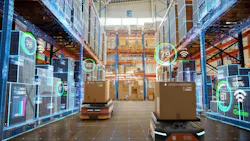
Several factors are causing warehouses to move AI from an experimental phase to an operational one. The converging forces, according to Gartner, include: labor constraints making automation non-negotiable, capital models shifting to lower-risk entry points, and AI and autonomy technologies reaching operational maturity.
Additionally, there are four globally disruptive AI trends set to transform warehousing, including:
- Enhanced Optimization-Oriented Traditional AI
- Operational-Driven Generative AI
- Suggestive and Semiautonomous Agents
- Physical AI Agents
“These four AI trends are interconnected and reflect the evolution of a more intelligent, adaptive and resilient warehouse environment,” said Federica Stufano, senior principal analyst in Gartner's supply chain practice, in a statement. “As labor pressures persist and AI technologies mature, organizations are moving beyond experimentation toward operational deployment. Their success will depend on building trust through transparent AI decision-making, enabling effective collaboration between workers and intelligent systems, and applying these technologies in ways that address specific operational challenges.”
Trend 1: Enhanced Optimization-Oriented Traditional AI
Enhanced optimization-oriented traditional AI is advancing beyond rule-based and statistical models by leveraging richer real-time data and more sophisticated algorithms. Modern demand forecasting, labor planning, route optimization and inventory management applications continuously adapt to changing warehouse conditions, improving cost savings, resource utilization and return on investment while maintaining the transparency and repeatability that have made traditional AI effective in warehouse environments.
Trend 2: Operational-Driven Generative AI
Operational-driven generative AI uses advanced machine learning models to synthesize actionable content, plans and operational insights from unstructured and semi-structured data. These capabilities enable the generation of dynamic standard operating procedures, work instructions, exception-handling protocols and decision support tools that can be embedded directly into warehouse operations, improving agility and supporting faster decision making.
Trend 3: Suggestive and Semiautonomous Agents
Suggestive and semiautonomous agents bridge the gap between manual operations and full autonomy by analyzing data and recommending or partially executing multistep workflows while maintaining human oversight. These agents help improve task assignments, exception handling, resource allocation and operational responsiveness, allowing warehouse organizations to increase productivity while keeping operators involved in critical decisions.
Trend 4: Physical AI Agents
Physical AI agents combine AI, robotics and advanced sensor technologies to automate manual warehouse activities. These systems can perform tasks such as picking, packing, sorting and material handling, with high levels of precision and consistency, increasing throughput, enhancing workplace safety and helping organizations address ongoing labor challenges while scaling operations more effectively.
“Supply chain leaders should take a pragmatic approach to AI in warehousing by tackling proven use cases, such as labor forecasting and slotting, and expanding into generative AI and agents where it can improve decision-making and workforce productivity,” said Stufano, in a statement. “Maintaining human oversight while continuously evaluating new use cases will be critical to realizing AI's full potential across the supply chain."