Roundup: Effects of Iran War on Supply Chains
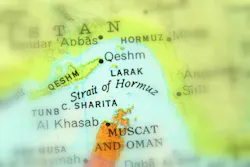
The uncertainty of the war in Iran and whether it will end tomorrow or drag on for months has logistics leaders questioning the underpinnings of their supply chain strategy.
A recent article from FTI Consulting offers some strategic moves companies can make to make their current and long-term strategies more effective.
Diesel Fuel Prices
The nearly 30% spike in diesel costs is one that “no operator can absorb quickly,” the authors note. They expect fuel surcharges across truckload, LTL and intermodal to remain elevated as long as oil prices stay high.
They suggest this strategic move.
Shippers should audit fuel surcharge mechanisms across all carrier contracts and assess exposure. Locking in fuel hedges or renegotiating surcharge caps where possible offers partial insulation. Carriers should accelerate investment in fuel efficiency and alternative-fuel fleets to reduce long-term exposure.
Ocean Freight
With the Strait of Hormuz allowing very limited access, carriers' insurance war-risk premiums have increased dramatically. This has impacted container rates and increased transit times as ships are adding ten days to two weeks using alternative routes.
The authors suggest this strategic move.
Importers should pressure-test supply chain resilience: identify suppliers in non-Gulf-exposed origins (where possible) and pull forward inventory, increasing safety stock levels for high-velocity Stock Keeping Units (“SKUs”).
Helium
At this point in the war, supply chain interruption has gone beyond oil. In fact, a critical gas, helium, is at risk according to an analysis in Business Insider.
Helium is used in high-tech AI hardware and is a key input for semiconductors, industrial manufacturing, and medical imaging.
Naomi Buchanan reports that the Qatari liquified natural gas plant accounts for almost one-fifth of the global LNG trade and is responsible for a substantial portion of the global helium supply, given that the gas is extracted as a byproduct of LNG processing.
Qatar is one of the world's largest helium producers, second only to the US, making more than a third of the world's helium in 2025, according to US Geological Survey data.
The article quoted research from The Kobeissi Letter found which found that the "market is now losing ~5.2 million cubic meters of helium per month, with almost no spare capacity globally, as helium evaporates during storage and must reach end users within ~45 days."
The research also indicated that helium prices have doubled from the supply shock and could surge another 25% to 50% if the disruptions are prolonged, Buchanan reported.
Pharmaceutical drugs
The global pharmaceutical trade has also been affected, especially those medicines with short shelf lives, such as vaccines, insulin, biologics, and cancer therapies, according to Think Global Health, a Council on Foreign Relations initiative, Buchana reported..
An article posted on Stat on March 23 offered the following analysis on the pharma supply chain.
The escalating war in the Middle East so far has not appreciably disrupted global pharmaceutical supply chains, but with no clear end in sight, the potential exists for the conflict to change the calculus for production, shipping, and, ultimately, pricing for different medicines in different countries, STAT explains.
For now, the greatest impact is likely to occur in the immediate region, where only a smidgen of the world’s medicines and active pharmaceutical ingredients — 0.3% and 0.6%, respectively — are produced, according to US Pharmacopeia, an independent organization that develops standards for medicines and tracks global supplies.
Nonetheless, the conflict is already disrupting key global shipping and air corridors, suggesting manufacturers — especially those in India and the European Union that are vulnerable to closures in the Strait of Hormuz — will need to find alternate transportation routes. And this raises expenses that may eventually get passed on to customers.
Freight Update
Judah Levine, Freightos' Head of Research, offers information and insights for the week’s happenings.
Key insights:
- Carriers have developed alternate ocean and road routes for Gulf-bound containers, but these alternatives aren’t designed for the current volumes. Aside from steep costs – Freightos Terminal shows Shanghai-Jebel Ali up to more than $7k/FEU – these ports are already facing serious congestion.
- A month into the war, container rates beyond the Gulf remain stable. Carriers have announced industry-wide emergency fuel surcharges set for the coming days, and a long list of GRIs and PSSs on many lanes starting in April. The coming weeks will show which increases carriers choose to introduce, and how successful they can be as slow season begins.
- In air cargo, Qatar has now joined the UAE in partially reopening its airspace, and Qatar Airways is set for 45 freighter flights as well as many passenger services this week, with Emirates flying more than 160 freighter flights this week as their recovery continues.
- Despite these capacity additions and European and Far East carriers adding Asia-Europe flights, rates, which had spiked initially but levelled off last week – have started to climb again, possibly on reports of growing backlogs at key hubs and rising fuel costs.
- South East Asia - Europe prices up 17% since last week to more than $5.00/kg, China - Europe rates up 23% to $5.00/kg too, China - US prices up 9% to $7.43/kg and Europe - Middle East rates up 14% to $3.18/kg.
Ocean rates - Freightos Baltic Index:
- Asia-US West Coast prices (FBX01 Weekly) increased 3% to $2,105/FEU.
- Asia-US East Coast prices (FBX03 Weekly) increased 4% to $3,118/FEU.
- Asia-N. Europe prices (FBX11 Weekly) stayed level at $2,870/FEU.
- Asia-Mediterranean prices (FBX13 Weekly) stayed level at $4,264/FEU.
Air rates - Freightos Air index:
- China - N. America weekly prices increased 9% to $7.28/kg.
- China - N. Europe weekly prices increased 25% to $5.01/kg.
- N. Europe - N. America weekly prices stayed level at $2.43/kg.
Analysis for the week
"The number of vessels transiting the Strait of Hormuz remains minimal, though it has increased in the last week as Iran announced it is allowing non-enemy vessels to pass.
Container traffic to the Gulf States has found alternate but ultimately insufficient routes. Most carriers are relying on ports on the west coast of India as tranship hubs and shuttle services to accessible ports in Oman and the UAE – with some also using north Red Sea transits to Jeddah, especially for volumes out of Europe – and road transport on to the final destinations.
But these port and road alternatives are not designed to handle these types of volumes, and in addition to the expense – Freightos Terminal shows Shanghai - Jebel Ali rates are now above $7,000/FEU – the routes are being plagued with delays and congestion. Vessels arriving at the UAE’s Khor Fakkan port are reportedly facing more than week-long waits for a berth with some being turned away, and truck shortages are delaying road transport as well.
But even as we approach a month since the start of the war, the container market beyond the Gulf region has not faced operational disruptions. And so far, container rates on the major lanes haven’t increased much either, with transpacific prices up just 3% last week to $2,100/FEU to the West Coast and 4% to $3,100/FEU to the East Coast. Asia - Europe rates were unchanged at $2,870/FEU to N. Europe and $4,264/FEU to the Mediterranean.
Carries have announced emergency fuel surcharges across lanes ranging from $200 to $500/FEU most of which will only go into effect in the coming days. They have also announced a long list of PSSs and GRIs – most set for early April – for non-Gulf lanes, including about $2,000/FEU rate increases for Asia - Europe lanes, though CMA CGM recently reduced its increase by about $700/FEU.
So, container rates may be set to climb on across the board fuel surcharges soon and possibly spike more significantly via other rate increases on some lanes to start April too. But there are some signs of pushback against the Strait of Hormuz closure driving rates up too far on non-impacted lanes. "
Besides shipper concerns that contracted BCOs who pay the emergency fuel surcharges may be double charged when BAFs are updated for Q3, the US FMC just rejected an early-March request by some carriers to waive the 30-day notice period for fuel surcharges because carriers did not provide data showing that the rate increases were reasonably related to cost increases. Indian authorities have also opened a streamlined channel to hear complaints of predatory logistics pricing.
Carriers – after a tepid post-Lunar New Year period from a volume perspective – are also facing the challenge of slumping demand as slow season begins. Rate behavior in the next few weeks then, should reflect which rate increases carriers try to introduce, and their degrees of success.
In air cargo, Gulf carriers continue their gradual schedule recovery. Qatar Airways – whose Doha operations were largely suspended since the start of the war as airspace was closed – started a partial reopening this week including about forty five weekly freighter flights, alongside many passenger services as Qatari airspace starts to reopen. The UAE began reopening its airspace soon after the war began, with Emirates Skycargo announcing more than 150 scheduled freighters for this week.
But despite the continued Gulf carrier capacity recovery and European and Asian carriers adding Asia - Europe flights, capacity out of the Middle East, and Asia - Europe tonnage are still much lower than a year ago.
Air rates which had spiked on many Middle East lanes, and Asia - Europe routes early in the war – as capacity out of the Gulf dropped and volumes shifted to direct Asia - Europe services – had leveled off last week. This week though, rates on some lanes have started climbing again, possibly reflecting the first reports of backlogs developing across major hubs, and updated fuel surcharges as fuel costs continue to rise. South East Asia - Europe prices up 17% since last week to more than $5.00/kg, China - Europe rates up 23% to $5.00/kg too, China - US prices up 9% to $7.43/kg and Europe - Middle East rates up 14% to $3.18/kg."
About the Author

Adrienne Selko
Senior Editor
http://mhlnews.com
Adrienne Selko is also the senior editor of EHS Today and a former senior editor of IndustryWeek.