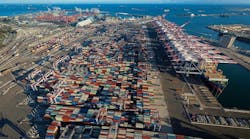
Overview of Logistics Disruptions in October

The logistics sector has been affected by a record number of disruptions, from natural disasters and weather events to conflict and cyberattacks.
An analysis from Transportation Insight (TI) offers an analysis of the impact of these disruptions in October.
Trade tensions
Trade has held up better than expected. The World Trade Organization’s updated outlook, released on October 8, puts merchandise trade growth at 3.9% for 2026 against the 1.9% expected in March, and 4.1% for 2027.
The WTO credits supply chains that have “adapted to disruptions in energy and fertilizer markets,” plus a 30% rise in AI-related hardware trade volume.
Even exposed cargoes held up: crude oil volumes fell just 6% and LNG 1%. The adjustment is regional, not uniform. Asian import and export volumes grew 9.9%, while Middle East exports fell 17.2% and imports 15.4%.
The IMF's October World Economic Outlook describes the same adjustment with more caution. It expects global growth to ease from 3.5% in 2025 to 3.1% in 2026, and trade growth to slow from 5.0% to 4.6%.
Chinese exports to the United States fell 22% between February 2025 and January 2026, with shipments to other markets recovering roughly half the affected volumes.
Rerouted trade is not lost trade, but it is harder to plan capacity against, and companies can only absorb higher costs for so long.
Geopolitical and security
Attacks on shipping around the Strait of Hormuz have moved from harassment to sinkings. The 2,824 TEU feeder GFS Pride was struck on October 13, caught fire and sank. The Maritime and Port Authority of Singapore said the Singapore-flagged vessel was “struck by unknown projectiles,” with all crew evacuated.
A second Global Feeder Shipping vessel, the GFS Giselle, was damaged in a similar attack and reached a safe anchorage. Media reports suggest Iran is now firing 30 to 40 projectiles a week at shipping, with UK Maritime Trade Operations reporting several serious incidents a day.
Houthi missile strikes also hit Saudi airports, including King Khalid International in Riyadh. With Dubai and Doha operating, the airfreight effect is indirect: non-regional carriers are increasingly reluctant to overfly the region, thinning global capacity.
The IMF now assumes Hormuz reopens in March 2027, with conditions normalizing by October 2027, a longer disruption than previously anticipated. Oil reached $126 a barrel in March and is expected to average around $96 in 2026, with refined product prices 70% to 95% above pre-war levels.
Civil unrest in France damaged or looted an estimated 1,500 retail stores, and Sephora temporarily closed its French network. No transport operator has yet quantified the freight impact. Further demonstrations are reported for 5 November.
Dockworkers struck over arms shipments on 30 October. Reuters reported action at 113 ports in 22 countries, with cargo operations disrupted at Piraeus as about 3,000 dockworkers and seafarers walked out.
Elsewhere, the effect was limited: AP reported Italy’s accompanying general strike caused less disruption than anticipated, and Marsh’s Marcus Baker judged a 24-hour stoppage unlikely to significantly disrupt global trade.
Natural disasters and weather events
Typhoon Champi was the fourth typhoon in seven weeks to hit East Asian port networks. Drewry Supply Chain Advisors’ Chantal McRoberts told The Loadstar on October 22 that the cumulative effect is what matters: in week 39 ships waited about 3.4 days at Shanghai against a global average of 1.3, and recovery takes around five weeks in a quiet period, up to two months in peak, raising the risk that delays roll into the pre-Lunar New Year rush. Maersk told customers that East China waiting times were declining, while warning of continued intermittent delays.
Champi closed Kaohsiung, Taipei and Keelung on 23 October, with Ningbo and Shanghai under emergency response from October22-26, according to ChemAnalyst. The Loadstar reported on October 27 that vessels were delayed by up to three days, and that the support this lends to rates is unlikely to reverse the market’s direction.
Europe was hit the same week: ChemAnalyst reports Storm Austen closing Le Havre’s Normandy Terminals on October 23 and ECT Rotterdam from October 23-25.
Cyber and ICT vulnerability
After a September with no logistics cyber incident at all, October produced two significant exposures and no operational disruption.
The n0n group posted 38 maritime and logistics organizations across 18 countries to its leak site on October 12, according to SOCRadar, which reviewed demands of $2.4 -$14 million.
Named entries include Ocean Network Express, CULines and T.S. Lines, plus terminal operators and port IT suppliers. SOCRadar says the pattern points to one exposed shared application rather than 38 separate intrusions, but states this has not been confirmed. What is claimed is data: EDI messages, manifests, gate records and terminal configuration.
No listed organization has publicly confirmed an incident, and no account of what followed the deadline has appeared.
The PHP2Shell flaws have the same shape. Two unauthenticated remote code execution vulnerabilities in PHP, both scored 9.2, were patched on October 21 and added to the US cyber agency CISA’s Known Exploited Vulnerabilities catalogue on October 26.
Check Point puts transport and logistics among the more exposed sectors at 14%, but defines that as exploitation attempts and says it cannot tell whether any succeeded. No logistics organization has been confirmed compromised.
Both turn on dependence on shared infrastructure that no single operator controls, and neither moved a container. Exposure, not outage, is the October story.