Logistics Impact of AI Buildout
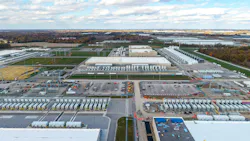
The physical buildout of AI has consequences for the logistics sector, according to a new survey from Prologis.
Prologis Research forecasts 150 million square feet or more of associated leasing through the end of the decade.
Year-to-date in 2026, companies serving the buildout of data centers and related infrastructure accounted for nearly 15% of new leasing activity in the top 30 U.S. markets, and we expect 40 to 50 MSF of total related net absorption in 2026.
This build-out is in early stages and friction – in the form of regulatory challenges, supply chain shortages and competition for scarce land, labor and utility access – could result in a longer timeline to match supply with demand.
Survey Highlights
AI infrastructure is a meaningful new source of logistics demand. Prologis Research forecasts more than 150 million square feet of associated leasing by the end of the decade. The opportunity includes an integrated supply chain of manufacturers, suppliers, contractors, 3PLs, and service providers that build and support data centers.
Based on historic non-ecommerce warehouse employment patterns, this growth could be associated with up to 150,000 jobs.
This demand is durable. Multi-year construction pipelines form a visible runway for demand, balanced between requirements for construction and fit-out and those that will sustain data center operations over the long term.
While nearly all demand will be needed for 5+ years, Prologis estimates 50% of generated demand and related jobs will be truly permanent, needed for ongoing maintenance, equipment replacement, and upgrades.
The data center buildout is adding hurdles to logistics development. Data centers compete for land, power, materials, and labor, raising physical and economic barriers to new logistics development and supporting the value of existing logistics real estate space.
Data Center Increases Competition
Data centers compete for many of the same inputs needed to develop logistics facilities: land, power, construction materials and skilled labor. In the largest data center markets, that competition is raising development costs and reducing the land available for logistics use.
Land competition is fierce. Sites with sufficient power capacity can command substantial premiums to traditional industrial land. In Georgia, for example, power-ready data center land averages approximately 3.5 times the value of comparable industrial land after entitlement and power-access costs.
The premium reflects the limited number of sites that can support large power loads and the higher value data center developers can create from them.
Data center development in many cases removes land that could have become logistics facilities. For every 1 GW of data center development, we estimate that approximately 10 MSF of potential logistics development capacity is removed.
Each GW requires roughly 5 MSF of data center building area, with variation by building design and purpose, but considerably more land is needed for substations, transformers, security setbacks, and cooling infrastructure than a traditional warehouse would require. Floor-area ratios are therefore typically around 20 percent, roughly half those of logistics facilities.